
- Home
- Academics
- Admission
- Faculties
- Faculty of Agriculture
- Faculty of Arts
- Faculty of Basic Medical Sciences
- Faculty of Biological Science
- Faculty of Business Administration
- Faculty of Dentistry
- Faculty of Education
- Faculty of Engineering
- Faculty of Environmental Studies
- Faculty of Health Sciences
- Faculty of Law
- Faculty of Medicine
- Faculty of Pharmaceutical Science
- Faculty of Social Science
- Faculty of Physical Science
- Faculty of Veterinary Medicine
- Faculty of Vocational Technical Education
- Institutes
- Centers
- Centre for American Studies
- Centre for Basic Space Research
- Curriculum Development and Instructional Materials
- CEMAC
- Centre for Igbo Studies
- Resource and Environmental Policy Research Centre, Environment for Development (REPRC-EfD)
- View More…
- Centre for Energy Research and Development
- Centre for Entrepreneurial and Development Research
- Centre for Rural Development and Co-operatives
- Centre for Technical and Vocational Education, Training and Research
- VIEW MORE…
- CRDC
- Distance Learning Programme
- UNN Consult
- YOUTH FRIENDLY RESOURCE CENTRE
- ACESPED UNN
- Vaccine Research Centre
- READ MORE…
- Biotech Centre
- Space Centre
- Computing Centre
- Equipment Centre
- Medical Centre
- Youth Friendly Centre
- Climate Change
- VIEW MORE…
- Information & Communication Technology Centre
- Energy Research Centre
- Resource & Environmental Policy Research Centre
- Directorate of Strategic Contacts, Ethics & Publications
- Gender & Development Policy Centre
- VIEW MORE…
- Administration
- Libraries
- Campuses
- Registry
- Alumni
- CDeL
- Open Edu.Res.
- ICT Center
- MPA
- News
- Portal
- General Information
- Students
- UNN Portal
- E-Learning MOODLE
- Student Union
- Postgraduate School
- Security Hotlines
- CDeL
- Unicorps
- CBT Exam Time Table
- Campus Life
- Students Population
- Prospective Students
- iTranscript
- UNN Online School
- FAQ
- Open Edu. Resources
- Foreign Students
- Religious Groups
- View Registered Courses
- CBN-CPP Advertisement Admission
- Staff
- College of Postgraduate Studies
- Our Youtube
- UNN Mart
- TETFund Intervention
- Special Intervention
- Annual Intervention
- 2025 Tetfund Projet Allocation
- Physical Infrastructure/Program Upgrade
- Academic Staff Training and Development
- Library Development
- Conference Attendance
- Teaching Practice
- Institution Based Research
- ICT Support
- Academic Research Journal
- TETFund Project Maintenance
- Equipment Fabrication
- Entrepreneurship
- Academic Manuscript Development
- Giving/Donations
- Enterprises
- FAQs
- UNN Mail
- ResearchGate
- Contacts
All Events Listings
3rd Supplementary Postgraduate Programmes Advert 2017/2018 Session
UNIVERSITY OF NIGERIA, NSUKKA SCHOOL OF POSTGRADUATE STUDIES 3RD SUPPLEMENTARY POSTGRADUATE PROGRAMMES ADVERT 2017/2018 The University of Nigeria, Nsukka invites...
Read More
2016/2017 Second Semester CBT Examination Status Table Update
2016/2017 SECOND SEMESTER CBT EXAMINATIONS STATUS TABLE S/N Client Dept Courses No of Students Coordinator Exam...
Read More
2ND SUPPLEMENTARY ADVERT FOR ADMISSION INTO PG PROGRAMMES
UNIVERSITY OF NIGERIA NSUKKA SCHOOL OF POSTGRADUATE STUDIES 2ND SUPPLEMENTARY ONLINE ADVERT FOR ADMISSION INTO POSTGRADUATE PROGRAMMES FOR...
Read More
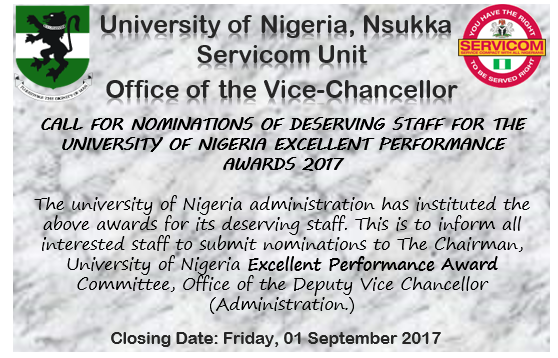
Call For Nominations Of Deserving Staff For The University Of Nigeria Excellent Performance Awards 2017
CALL FOR NOMINATIONS OF DESERVING STAFF FOR THE UNIVERSITY OF NIGERIA EXCELLENT PERFORMANCE AWARDS 2017
Read More
Our Students, Once More, Have Demostrated Our Culture Of Excellence
OUR STUDENTS, ONCE MORE, HAVE DEMONSTRATED OUR CULTURE OF EXCELLENCE It is no longer news that University of Nigeria, Nsukka...
Read More
WARMREG Inception Workshop Success Story
WARMREG Inception Workshop Success Story The Waste & Resource Management Research Group (WARMREG), University of Nigeria Nsukka held its inception...
Read More
2016/2017 Second Semester CBT Examinations Status Table
2016/2017 SECOND SEMESTER CBT EXAMINATIONS STATUS TABLE S/N Client Dept Courses No of Students Coordinator Exam...
Read More
Annual Conference of the Association for Childhood Educators, Nigeria (ACEN)
The Annual Conference of the Association for Childhood Educators, Nigeria (ACEN), a professional organization of the Childhood Unit of the...
Read More
CALL FOR NOMINATIONS OF DESERVING STAFF FOR THE UNIVERSITY OF NIGERIA EXCELLENT PERFORMANCE AWARDS 2017
UNIVERSITY OF NIGERIA OFFICE OF THE VICE CHANCELLOR CALL FOR NOMINATIONS OF DESERVING STAFF FOR THE UNIVERSITY OF NIGERIA EXCELLENT...
Read More
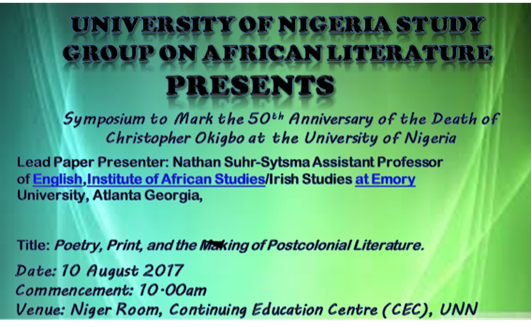
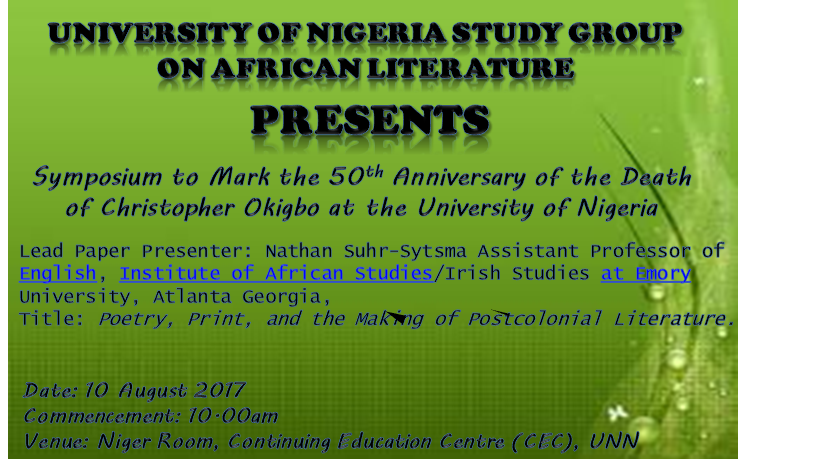
University of Nigeria Study Group on African Literature
University of Nigeria Study Group on African Literature Dear all Symposium to Mark the 50th Anniversary of the Death...
Read More
Attention: Students Taking CHM 112
As you come for the exam on 3rd August 2017, you are expected to come with 1 (one) clean sheet...
Read More
Postgraduate Training Support
Postgraduate training support Calls for grant applications or/and letters of interest Postgraduate training grants now available TDR supports 7 universities...
Read More
Orientation Exercise For 2017 Student Vacation Job Successful Candidates
All successful candidates in the 2017 Student Vacation Job interview are invited to an Orientation exercise as follows: Date: Tuesday...
Read More
Institute of Education 2017 Annual Conference
Institute of Education 2017 Annual Conference CLICK DOWNLOAD FOR MORE INFORMATION For further enquires click here
Read More
Schedule for COS304 CBT EXAM @ UNN and UNEC
SCHEDULE FOR COS304 CBT EXAM @ UNN and UNEC 2nd August, 2017 Please, come with your UNN ID card. S/N...
Read More
3rd Supplementary Postgraduate Programmes Advert 2017/2018 Session
UNIVERSITY OF NIGERIA, NSUKKA
SCHOOL OF POSTGRADUATE STUDIES
3RD SUPPLEMENTARY POSTGRADUATE PROGRAMMES ADVERT 2017/2018
The University of Nigeria, Nsukka invites applications from suitably qualified candidates for admission into postgraduate programmes leading to the award of Postgraduate Diplomas, Master’s and Doctorate degrees in various Faculties and in the areas of specialization indicated under each Department/Institute/Centre as follows for the 2017/2018 academic session:
1. FACULTY OF AGRICULTURE
PGD, M.Sc. and Ph.D. programmes
A. Department of Agricultural Economics
Farm Management and Production Economics; Agricultural Marketing and Agribusiness; Agricultural Finance and Project Analysis; Agricultural Cooperative and Resources; Environmental Economics.
The Department of Agricultural Economics also offers PGD programme in Co-operative Studies; Farm Management and Production Economics; Agribusiness and Marketing.
Departments of Food Science and Technology, Crop Science, Animal Science, Agricultural Extension and Soil Science, offer Postgraduate Diploma Programmes.
B. Department of Animal Science
Animal Nutrition and Biochemistry; Animal Production; Animal Physiology; Animal Breeding and Genetics.
C. Department of Crop Science
PGD, M.Sc. and Ph.D.
Crop Physiology Economic Entomology; Crop Production; Forage Crops; Hematology; Innamental Horticulture; Plant Breeding and Genetics; Plant Pathology; Tropical Fruits and Plantation Crops; Vegetable Crops; Weed Science.
D. Department of Agricultural Extension
Agricultural Administration; Agricultural Communication; Agricultural Extension Education; Agricultural Planning and Evaluation or Rural Sociology.
E. Department of Food Science and Technology
Food Chemistry and Analysis; Animal Production Technology; Fruits and Vegetable Processing Technology; Quality Control and Assurance; Cereals, Pulses, Legumes and Tuber Processing Technology; Food Biotechnology; Food Engineering and Processing.
F. Department of Home Science, Nutrition and Dietetics
PGD, M.Sc. and Ph.D. programmes in Home Science, Nutrition and Dietetics.
G. Department of Soil Science
Soil Genesis; Survey and Classification; Soil Chemistry and Mineralogy; Soil Fertility and Management; Soil Physics and Conservation; Soil Biology and Biochemistry; Environmental Impact Assessment and Land Evaluation.
2. FACULTY OF ARTS
PGD, M.A. and Ph.D. degree programmes
A. Department of Archaeology and Tourism (PGD, M.A. and Ph.D. Programmes)
Paleolithic Studies; Iron Age Archaeology; Origins of Food Production and Urbanization; and Cultural Resource Management (Museum or Tourism Option).
B. Department of English and Literary Studies (PGD, M.A and Ph.D.)
English as a second Language (ESL); English Language; Literature; and Comparative Studies and Literature.
C. Department of Fine and Applied Arts
Ph.D. Art History; Ph.D. Art Education; Ph.D. Art Administration and Management; Ph.D. Fine Arts and Design (with specialization in Painting, Print Making; Sculpture-Visual Communication Design; Textile Design; Fashion Design; Ceramics).
M.F.A. with specialization in Painting; Print Making; Sculpture; Textile Design; Fashion Design; Ceramics; Communication Art and Design (Options: Graphic Design and Advertizing; Product Design; Web Design and New Media); Film Making and Photography.
M.A. Art History: Traditional African Art; Modern African Art; Asian Oriental Art; African-American Art.
M.A. Art Education; M.A. Art Administration and Management
PGD in Fine and Applied Arts.
D. Department of Foreign Languages and Literary Studies (MA programme)
African Literature in French; German Literature; Caribbean Literature in French; Translation (FEENG – FRE).
The Department also offers Ph.D programmes in the following areas of specialization:
African Literature in French; Caribbean Literature in French; German Literature.
E. Department of History and International Studies (M.A. and Ph.D.)
Political History; Economic and Social History; and Religious History.
F. Department of Linguistics, Igbo and Other Nigerian Languages (M.A)
Linguistics; African Languages; Literature in African Languages; and Translation and Interpretation).
The Department also offers Ph.D. in the following areas of specialization:
Linguistics; African Languages and Literature.
G. Department of Mass Communication
PGD, M.A and Ph.D.
Electronic Media Sequence; the Print and Media Sequence; Advertising and Public Relations; Communication Theories and Research.
H. Department of Music
Postgraduate Diploma in Music (PGDM)
(a) African Music Industry.
(b) Ensemble/Theatre Directing and Management.
(c) Music Education.
(d) Research.
(e) Composition and Musical Instrument Technology.
MA Degree Programme
(a) Ensemble/Theatre Directing and Management
(b) Music Education.
(c) Research.
(d) Composition and Musical Instrument Technology.
Ph.D. Degree Programme
(a) African Music.
(b) Music Education.
(c) Composition.
(d) Musicology.
(e) Music Performance and Musical Instrument Technology.
(f) Ensemble/Theatre Directing and Management.
(g) Research and Musical Instrument Technology.
I. Department of Theatre and Film Studies
(M.A and Ph.D.)
(a) Acting and Directing.
(b) Dramatic Theory and Criticism.
(c) Applied Theatre.
(d) Playwriting.
(e) African and Caribbean Drama and Theatre.
(f) Film and Media Arts Studies.
(g) Performance Studies.
(h) Scenography.
(i) Theatre and Cultural Administration.
3. FACULTY OF BIOLOGICAL SCIENCES
M.Sc. and Ph.D. programmes
A. Department of Biochemistry
Environmental Biochemistry; Enzymology; Industrial Biochemistry; Medical Biochemistry; Nutritional Biochemistry; Molecular Biology; and Pharmacological Biochemistry.
The Department also offers Ph.D programme in Lipid Biochemistry.
B. Department of Microbiology
Brewing Science and Technology (PGD); Medical Microbiology (M.Sc. and Ph.D.); Environmental Microbiology (M.Sc. and Ph.D.); Food/Industrial Microbiology (M.Sc. and Ph.D.); and Brewing Science and Technology (M.Sc).
C. Department of Plant Science and Biotechnology
Biosystematic/Taxonomy; Palynology/Palaeoecology; Plant Anatomy; Plant Physiology; Ecophysiology; Plant Pathology; Mycology; Genetics and Plant Breeding; Plant Ecology; Environmental Botany/Economic Botany; Plant Biotechnology; Bagel Biotechnology; Aquatic Botany; Phycology/Limnology (Aquatic Ecology); and Ethnomedicine/ Phytomedicine.
D. Department of Zoology and Environmental Biology
(M.Sc. and (Ph.D.)
(a) Animal and Environmental Physiology.
(b) Parasitology and Public Health.
(c) Entomology and Forensic Sciences.
(d) Fishery Science and Aquaculture.
(e) Hydrobiology/Aquatic Sciences.
(f) Ecology and Environmental Biology.
(g) Animal Genetics, Molecular Biology and Biotechnology.
4. FACULTY OF BUSINESS ADMINISTRATION
PGD, MBA, M.Sc and Ph.D. programmes
A. Department of Accountancy
Financial Accounting; Management Accounting, Auditing and Investigation; Taxation Laws and Accounts; Public Sector Accounting; Management Information System.
B. Department of Banking and Finance
Banking; Financial Theory and Management; Investment; Financial Institutions; International Finance and Public Finance.
C. Department of Management
Administrative Theory and Practice; Human Resources Management; Production and Operations Management; Analytical Techniques; Corporate Strategy and Business Policy; Project Management and Feasibility Analysis; and Comparative Management Systems.
D. Department of Marketing
Marketing Communications; Physical Distribution and Channel Management; Industrial Marketing; Consumer-Buyer Behaviour; and International Marketing, Strategic Marketing. The Department of Marketing also offers executive M.Sc. degree programme in Public Relations.
Faculty of Business Administration offers MBA degree broad-based professionally oriented programme in Accounting, Banking and Finance; Management and Marketing.
5. FACULTY OF EDUCATION
PGDE, PGDL, M.Ed. and Ph.D. degree programmes in the following Departments:
A. Department of Adult Education & Extra Mural Studies
Adult Education Administration; Community Development; Extension & Distance Education.
B. Department of Arts Education
Curriculum Studies; Language Education; Educational Technology; Comparative &International Education; Music Education; Fine & Applied Arts Education.
C. The Department of Educational Foundations
Childhood Education; Educational Psychology; Guidance & Counseling; History of Education; Philosophy of Education; Sociology of Education; Special Education.
D. Department of Human Kinetics and Health Education
Public Health Education; School Health Education; Mental and Emotional Health Education; Occupational and Industrial Health Education; Administration and Management of Physical Education and Sports; Curriculum and Physical Education Teacher Education; Psychology of Sports; Sociology of Sports; Recreation and Tourism; Exercise Physiology; Adapted Physical Education. For PGD: (a) Health Education (PGDHE); (b) Human Kinetics and Sports Studies (PGDHKS).
E. Department of Library & Information Science
M.L.S and Ph.D. Degree Programmes
F. Department of Science Education
Educational Research Methodology; Mathematics Education; Physics Education; Chemistry Education; Biology Education; Measurement & Evaluation, and Integrated Science Education.
G. Department of Social Science Education
Economics Education; Political Science Education; Population & Family Life Education; Geographical & Environmental Education; and Social Studies Education.
Postgraduate Diploma programmes in the Faculty of Education are domiciled as follows: (PGDE) in Educational Foundations; PGDL in Library & Information Science; Postgraduate Diploma in Environmental Education domiciled in the Department of Social Science Education.
6. FACULTY OF ENGINEERING
M.Sc., M.Engr. And Ph.D. degree programmes
A. Department of Agricultural & Bioresources Engineering: offers the following areas of specialization for the Master of Science (M.Sc.), Master of Engineering (M.Engr.) and Doctor of Philosophy (Ph.D) degree:
(i) Power Systems, Machinery and Mechatronic Engineering
(ii) Soil and Water Resources Engineering
(iii) Food and Bioprocess Engineering
(iv) Structures and Environmental Control Engineering
(v) Biomass and Renewable Energy Engineering
(vi) Aqua Cultural Engineering
(vii) Forest Engineering
(viii) Ecological Engineering
B. Department of Civil Engineering
(PGD, M.Sc., M.Engr, Ph.D)
Structural Engineering; Water Resources Engineering; Soil Mechanics & Foundation Engineering; Materials & Construction; and Highway Engineering.
C. Department of Electrical Engineering
Power Electronics, Drives and New System; Electrical Machine and Drives; Electromagnetic Fields and Application; Power Systems and High Voltage Engineering; and Automatic Control Systems.
D. Department of Electronic Engineering
(M.Sc, M.Engr and Ph.D)
Communications; Digital and Computer Electronics. Currently, the Department of Electronics Engineering has no facilities in the area of Control Systems.
E. Department of Mechanical Engineering
(PGD, M.Sc., M.Eng., Ph.D.)
Energy and Power Technology; Materials Technology and Mechanics; Fluid Mechanics and Gas Dynamics; Design and Production Technology; Industrial Engineering and Management.
The Departments of Civil Engineering and Mechanical Engineering offer PGD programmes.
7. FACULTY OF ENVIRONMENTAL STUDIES
PGD, M.Sc., M.Arch. and Ph.D. Programmes
A. Department of Architecture
Architectural Design; Architectural Science and Technology; Housing; Construction Management; Architectural History and Theory; Sustainable Design; Architectural Conservation; Architectural Practice and Management; Industrial Design; Landscape Architecture Design; Urban Design, Computer Aided Design/Technology and Media Architecture and Interior Design.
B. Department of Estate Management
(PGD, M.Sc., Ph.D. and Master in Real Estate (MRE) Programmes)
Valuation; Feasibility/Viability Appraisals; Taxation, Facility and Property Management; Development and Utilization and Land Resources inclusive of Estate and Interests tread as strongly rooted in Philosophical and Socio-economic foundations of their Relationship to man, society and environment.
C. Department of Geoinformatics & Surveying
(PGD, M.Sc., MGIT and Ph.D.)
(a) Land Surveying.
(b) Geodesy.
(c) Protogrammetry.
(d) Remote Sensing.
(e) Hydrography.
(f) Cartography.
(g) Geographic Information System (GIS).
(h) Land Information Management (LIM).
D. Department of Urban & Regional Planning
(MURP and Ph.D.)
Information Technology in Urban and Regional Planning; Traffic and Transportation Planning; Transportation Planning and Development; Conservation/Preservation; Housing and Community Development; Recreation and Facility Planning; Regional/Rural Analysis and Planning; Development Control; Environmental Management; and Social Science and Planning.
8. FACULTY OF HEALTH SCIENCES & TECHNOLOGY
M.Sc. and Ph.D. programmes
A. Department of Health Administration & Management
Health Economics; Health Management & Policy.
The Department of Health Administration also offers PGD programme.
B. Department of Medical Laboratory Science
Clinical Chemistry; Hematology; Histopathology; Microbiology; and Immunology.
C. Department of Medical Radiography & Radiological Sciences
Medical Imaging; Radiation/Environmental Protection; Radiological Education;
Radiotherapy & Oncology; and Radiology Administration & Management.
E. Department of Medical Rehabilitation
Physiotherapy; Path kinesiology; Biomechanics; and Neurology.
F. Department of Nursing Sciences
Maternal & Child Health Nursing; Medical Surgical Nursing; Mental Health & Psychiatric Nursing; Nursing Administration & Management; Community Health Nursing; and Nursing Education.
9. FACULTY OF LAW
LL.M. and Ph.D. Degree programmes in the Departments of
Public & Private Law; Property & Commercial Law; International Law & Jurisprudence.
Programme areas available in the Faculty are:
Jurisprudence & Legal Theory; Comparative Constitutional Law; Comparative Company Law; Comparative Criminal Law; Law of Commercial Transactions; International Human Rights Law; Energy & Natural Resources Law; Law of Commercial Arbitration; Sentencing & Treatment of Offenders; Law of Marine Insurance; and Law & Medicine.
10. FACULTY OF MEDICAL SCIENCES
M.Sc. and Ph.D. degree programmes are offered by the following Departments:
Anatomy; Medical Biochemistry; Pharmacology & Therapeutics; Human Physiology; Medicine and Surgery.
MPH degree programme is offered by the Department of Community Medicine in the following areas of specialization:
Department of Community Medicine
MPH in Public Health with specialization in the following area:
Epidemiology of Community Disease; Health Services Management/Health Economics, Occupational and Environmental Health; Social Medicine; Health Education; Maternal and Child Health.
Department of Pharmacology & Therapeutics
M.Sc. and DMSC degree programmes.
Department of Medicine
M.D. and M.S. degree programmes.
11. FACULTY OF PHARMACEUTICAL SCIENCES
M.Pharm, M.Sc., (Pharm); and Ph.D. degree programmes.
A. Department of Clinical Pharmacy & Pharmacy Management
Pharmaceutical Services e.g. drug information services; Pharmacotherapy of various units e.g. oncology, cardiovascular, neurology; Ambulatory Care/Adult Medicine; Clinical Pharmacokinetics/biopharmaceutics; Hospital Pharmacy; Pharmaceutical care; Social Pharmacy/Behavioural Pharmacy; Pediatric Pharmacy; Hematology; Pharmacy Practice Management; Infectious Diseases; Public Health Pharmacy; Pharmacoeconomics/ Pharmacoepidemicology; Social Pharmacy/Behavioural Pharmacy; Pediatric Pharmacy; Hematology; Pharmacy Management; and Infectious Diseases.
B. Department of Pharmaceutics
Physical Pharmaceutics; Compounding; Pharmaceutical Microbiology & Biotechnology; Dispensing; and Pharmacy practices.
C. Department of Pharmaceutical Chemistry
Natural Products Chemistry; Drug Metabolism; and Analytical Pharmaceutical Chemistry.
E. Department of Pharmaceutical Technology and Industrial Pharmacy
Powder and Tablet Technology; Semi-Solid Dosage Design; Cosmic Science; Liquid Formulations Technology; Biopharmaceutics and Pharmacokinetics.
F. Department of Pharmacology and Toxicology
Autonomic Pharmacology; Neuropharmacology; Biochemical Pharmacology; Chemotherapy; Clinical Pharmacology; Toxicology; Cardiovascular Pharmacology; Natural Product Pharmacology; Advanced General Pharmacology; Advanced Pharmacokinetics and Drug Interactions.
12. FACULTY OF PHYSICAL SCIENCES
M.Sc. and Ph.D. degree programmes
A. Department of Computer Science
Data Communication; Software Development; Numerical Analysis; Information Management; Software Engineering; Microprocessor Based Systems.
B. Department of Geology
(M.Sc. and Ph.D programmes in the following areas):
(a) Economic Geology and Geochemistry
(b) Engineering Geology
(c) Environmental Geology
(d) Applied Geophysics
(e) Hydrography
(f) Mineralogy and Petrology
(g) Paleontology and Stratigraphy
(h) Palynology
(i) Petroleum Geoscience
(j) Structural Geology
(k) Stratigraphy and Sedimentology
Applied Geophysics; Economic Geology and Geo-Chemistry; Mineral Exploration; Engineering Geology; Hydrogeology; Mineralogy and Petrology; Paleobiology and Biostratigraphy; Stratigraphy and Sedimentology; Petroleum Geology; and Structural Geology.
C. Department of Physics & Astronomy
Solid Earth Geophysics; Astrophysics; Condensed Matter Physics & Materials Science;
Solar Energy Physics; Atmospheric Physics; Medical Physics.
D. Department of Pure & Industrial Chemistry
Inorganic; Physical; Organic; Analytical; Fossil Fuel; Polymer; and Industrial Chemistry.
E. Department of Statistics
Stochastic Processes: Operations Research; Applied Statistics; Time Series Modeling, Design of Experiments.
13. FACULTY OF THE SOCIAL SCIENCES
PGD, M.Sc. and Ph.D degree programmes
A. Department of Economics
Economic Theory; Economic Development and Planning; International Economics, Money and Banking; Labor Economics and Industrial Relations; Quantitative Economics; Energy Economics; Public Sector Economics.
B. Department of Geography
Geomorphology; Climatology and Physical Oceanography; Hydrology and Water Resources; Biogeography; Cartography; Remote Sensing; Environmental Management; Agricultural Geography; Rural Geography; Urban Geography; Industrial Geography; Transportation Geography; Population Geography; Political Geography; Climate Change Economics; and Policy & Innovation.
C. Departments of Philosophy
Political and Social Philosophy; Western Metaphysics; Moral Philosophy; History of Western Philosophy and African Philosophy.
D. Department of Political Science
(M.Sc and Ph.D. programmes in the following areas):
(a) Political Theory
(b) Public Administration
(c) Comparative Politics, Development and Social Change
(d) Electoral Studies
(e) International Relations and Diplomacy
(f) Political Economy
(g) Conflict, Peace and Strategic Studies
(h) Human Security and Counter-Terrorisms Studies.
E. Department of Psychology (M.Sc. & Ph.D. degree programmes)
Experimental Psychology; Developmental Psychology; Clinical Psychology; Industrial/Organizational Psychology; Social Psychology; School Psychology; and Counseling Psychology.
F. Department of Public Administration and Local Government
MPA, M.Sc., DPA& Ph.D. degree programmes.
Financial Management; International Administration; and Human Resources Management.
G. Department of Religion & Cultural Studies
M.A. and Ph.D degree programmes
Old Testament; New Testament; Church History; Traditional Religion; Religion and Society.
Departments of Religion & Cultural Studies and Philosophy do not offer PGD programmes.
H. Department of Sociology/Anthropology
M.Sc. and Ph.D. degree programmes in the following areas:
Anthropology; Anthropology and Development; Climate Change and Society; Comparative Ethnography; Criminology and Sociology of Deviance; Culture and Communication; Demography and Population Studies; Environmental Sociology; Family Studies; Gender and Women Studies; Industrial and Labour Relations; Industrial Sociology; Medical Anthropology; Medical Sociology; Military Sociology and Diplomacy; Oral Tradition and Sociology; Organizational Sociology; Political Anthropology; Political Sociology; Postcolonial Studies; Rural Sociology; Security Studies; Social Development Studies; Social Institutions; Symbolic Anthropology; Urban Anthropology; Urban Sociology.
The Department of Sociology/Anthropology also offers PGD programme in the following areas:
Criminology; Gender and Women Studies; Industrial and Labour Relations; Social Development Studies.
I. Department of Social Work
(PGD, M.Sc. and Ph.Ddegree programmes)
Intervention; Social Work Ethics & Values; and Community Development.
The Department also offers PGD in Political Science and Election Administration.
14 FACULTY OF VETERINARY MEDICINE
M.Sc. and Ph.D. degree programmes
A. Department of Veterinary Anatomy
Neuroanatomy; Developmental Anatomy Embryology; Microscopic Anatomy (Histology); Gross and Comparative Anatomy; Immunochemistry; Histochemistry; and Applied Anatomy and Biotechnology.
B. Department of Animal Health and Production
(M.Sc. and Ph.D. Degree Programmes)
Large Ruminant Health and Production; Small Ruminant Health and Management; Dairy Animal Health and Production; Nutrition in Health and Disease; Swine Health and Production; Nutrition and Management; Animal Genetics and Breeding; Animal Health Management and Economics.
C. Department of Veterinary Medicine
(M.Sc., and Ph.D. Degree Programmes)
Avian Medicine; Ruminant Medicine; Small Animal Medicine; Swine Medicine; Equine Medicine; Fish Laboratory and Wildlife Medicine; Ethnoveterinary Medicine.
C. Department of Veterinary Obstetrics & Reproductive Diseases
Veterinary Andrology; Gynaecology; Obstetrics and Reproductive Biotechnology.
D. Department of Veterinary Parasitology and Entomology
(M.Sc., and Ph.D. Degree Programmes)
Parasitic Infections; Parasite Zoonoses; Clinical Aspects; Epizootiology; Diagnosis and Control.
E. Department of Veterinary Pathology and Microbiology
(M.Sc., and Ph.D. Degree Programmes)
(i) Veterinary Pathology: Diagnostic (Anatomic) Pathology; (Clinical Pathology (Haematology and Clinical Chemistry); Avian Pathology Nutritional Pathology.
(ii) Veterinary Microbiology: Bacteriology; Virology; Mycology; Micoplasmology and Rickettsiology; and Immunology.
F. Department of Veterinary Physiology and Pharmacology
(M.Sc. and Ph.D. programmes)
G. Department of Veterinary Public Health and Preventive Medicine
(M.Sc., MVPH, MPVM and Ph.D. Degree Programmes)
(i) Public Health: Zoonoses; Food Safety; Including Meat, Fish and Milk Hygiene; Environmental Health and Occupational Safety.
(ii) Preventive Medicine: Epidemiology; Disease Surveillance; Emergency Preparedness and Information Management; Veterinary Quarantine Services; Livestock Production Economics and Entrepreneurship.
H. Department of Veterinary Surgery & Radiology
M.Sc., and Ph.D. degree programmes
Veterinary Surgery; Diagnostic Imagining; Anaesthesiology; Orthopedic; Soft Tissue Surgery; and Animal Surgery.
15. FACULTY OF VOCATIONAL AND TECHNICAL EDUCATION
PGDE, PGDTE, M.Tech., M.Ed. and Ph.D. degree programmes
A. Department of Agricultural Education
(PGDTE, M.Tech., M.Ed. and Ph.D.)
Technology Education in Production Agriculture; Agro-Business Education; Soil Education
B. Department of Business Education
(PGDTE, M.Tech., M.Ed. and Ph.D.)
Software Development and Application; Hardware Maintenance and Management; Networking Communication; Robotics Education; Accounting Education, Marketing Education and Management Education.
C. Department of Computer Education
(PGDTE, M.Tech., M.Ed. and Ph.D.)
(a) Software Development and Application.
(b) Hardware Maintenance and Management.
(c) Networking and Communication.
(d) Computer and Robotic Education.
D. Department of Home Economics and Hospitality Management
(PGDTE, M.Tech., and Ph.D.)
Child Development and Care Education; Clothing and Textile Technology Education; Food and Nutrition Education; Home Management; and Hospitality Management Education.
E. Department of Industrial Technical Education
(PGDE, PGDTE, M.Tech., and Ph.D.)
Building/Woodwork Technology; Electrical/Electronic Technology; Metal Work/Automobile Technology.
F. Department of Vocational and Entrepreneurship Education
Vocational Education (Masters and Ph.D.); Entrepreneurship Education (Masters and Ph.D.); Agricultural Education (PGDTE); Business Education (PGDTE); Computer Education (PGDTE); Home Economics and Hospitality Management (PGDTE); and Industrial Technical Education (PGDTE).
16. INSTITUTE OF AFRICAN STUDIES
Offers Postgraduate programmes as follows:
African Peace and Conflict Studies (PGD); African Studies (M.A, & Ph.D.); and Peace and Conflict Studies (MA).
17. INSTITUTE FOR DEVELOPMENT STUDIES (IDS)
PGD, M.Sc. & Ph.D. degree programmes
The IDS has the following areas of specialization at Masters (M.Sc.) degree level:
Governance and Social Change; Poverty, Power Relations and Social Change; Knowledge, Technology and Society; and International Development.
At Ph.D. degree level, the Institute has the following areas of specialization: Human and Social Development; Community Development; Conflict Resolution and Peace-Building; and Natural Resources and Sustainable Development.
18. INSTITUTE OF MARITIME STUDIES (IMS)
Offers postgraduate programmes as follows: M.Sc. and PGD in Maritime Business and International Logistics; M.Sc. and PGD in Maritime Law and Policy; M.Sc. in Maritime Telecommunication; PGD in Radio Maritime Telecommunication; and M. Sc in Maritime Management.
19. CENTRE FOR ENVIRONMENTAL MANAGEMENT & CONTROL
Centre for Environmental Management and Control (CEMAC) offers PGD, M.Sc. and Ph.D. degree programmes in Environmental Management & Control; Disaster Risk Management. The Centre also offers Master’s degree programmes in Disaster Risk Management (MDRM).
20. POSTGRADUATE PROGRAMMES IN CLIMATE CHANGE ECONOMICS, POLICY AND INNOVATION (CCEPI)
The Centre offers PGD, M.Sc. AND Ph.D. degree programmes in Climate Change Economics, Policy and Innovation. Presently, the PGD and degree programmes in Climate Change are based in the Department of Geography, Faculty of the Social Sciences.
21. INSTITUTE OF PUBLIC HEALTH
The Institute of Public Health offers M.Sc., DrPH and PhD. programmes in the following areas: Health Systems, Policy and Management; Epidemiology and Biostatistics; Health Promotion and Communication; Environmental and Occupational Health; Clinical Epidemiology; Biostatistics.
22. INSTITUTE OF MOLECULAR AND INFECTIOUS DISEASES
M.Sc. and Ph.D. programmes in the following areas: Tropical Paediatrics; Human Reproduction; Adolescent and Child Health; Women’s Health and Reproductive Science.
The Institute also offers Postgraduate Diploma programme in Maternal and Child Health (PGD Maternal & Child Health).
23. INSTITUTE MATERNAL AND CHILD HEALTH
Growth & Development; Genetics, Molecular and Cellular Biology; Paediatric Sub-specialty; ICT & Priority Advanced Research Methodology.
24. INSTITUTE OF EDUCATION (SANDWICH PROGRAMMES)
Offers Postgraduate Diploma (PGD) sandwich programmes in the following areas: Citizenship Education; Gender Education; Office Administration and Technology Education; and Women Education.
Entry Qualifications:
i. Citizenship Education: A minimum of Bachelors degree or HND passed at distinction or upper credit in Education, Social Sciences or related fields like Arts (Communication, Fine Arts, Drama and Languages).
ii. Gender Education: A candidate is qualified to apply with Bachelor’s degree or HND in any area of Education and Social Sciences, Arts and Sciences, passed at distinction or credit level.
iii. Office Administration and Technology Education: The entry requirement is Bachelor’s Degree or HND in any area of Education, Social Sciences, ICT or other professionals whose detailed academic records are acceptable to senate of the University of Nigeria may be admitted.
iv. Women Education: The entry requirement is Bachelor’s Degree or HND in any area of Education, Social Sciences, ICT or other professionals whose detailed academic records are acceptable to senate of the University of Nigeria may be admitted.
24. INSTITUTE OF CLIMATE CHANGE
Institute of Climate Change offers postgraduate programmes leading to the award of PGD, M.Sc. and Ph.D. degrees in the following areas: Science of Climate Change; Ground Based Measurement and Indigenous Technology Application to Climate Change; Environmental Literacy and Policy Studies on Climate Change; Sustainability Studies; Studies on Environmental and Climate Change Laws.
GENERAL ENTRY QUALIFICATIONS FOR POSTGRADUATE PROGRAMMES
i) Candidates for admission into any postgraduate programme of the University must have obtained 5 credits at not more than two sittings in WASC or GCE or NECO or NABTEB including English Language. Candidates shall also possess the minimum entry requirements for admission into the first degree and postgraduate programmes in their areas of interest for postgraduate studies.
ii) Graduates of the University of Nigeria or other recognized Universities who possess the above qualifications are eligible to apply.
iii) For the PGD in Civil Engineering, Mechanical Engineering, and Architecture, only candidates with University degrees in relevant areas need apply.
A. POSTGRADUATE DIPLOMA PROGRAMMES
i) Graduates of the University of Nigeria or other recognized universities who have obtained a bachelor degree with at least a third class honours with GPA not less than 2.00 on a 5-point scale or its equivalent.
ii) Holders of Credit (Upper credit) level passes at HND or its equivalent in relevant areas (for programmes in the Faculties of Agriculture and Business Administration; the Departments of Political Science, Public Administration & Local Government; and Vocational Teacher Education; and for Postgraduate Diploma in Electoral Administration Programme). Qualifications such as AIB, ACCA, ACMA, ICAN, BEEC, CPA, etc may also be considered for admission.
iii) Candidates with professional qualifications including HND must have obtained 5 credits in WASC or GCE O/L including English and Mathematics for admission into degree courses in Business Administration.
iv) For Postgraduate Diploma in Geoinformatics & Surveying in particular, candidates with third class honours degrees in Geography, Geology and other Physical Sciences, HND Upper Credit level passes in related fields, are also eligible.
Candidates, who hold qualifications other than the above which are acceptable to the Board of the School of Postgraduate Studies and Senate of the University, may also be considered for admission.
FACULTY OF AGRICULTURE
Entry Requirements in Nutrition and Dietetics (PGD)
For PGD programme in Nutrition and Dietetics, candidates must have any of the following qualifications from recognized institutions:
1. HND in Nutrition and Dietetics or Human Nutrition and Dietetics or Human Nutrition or Dietetics with a minimum of Upper Credit or Third Class Bachelor’s Degree in Nutrition and Dietetics or Human Nutrition and Dietetics or Human Nutrition or Dietetics or related discipline.
2. M.Sc in Nutrition and Dietetics: Candidates seeking admission into M.Sc. in Nutrition and Dietetics must have obtained as follows:
a) HND (Upper Credit) in Nutrition and/or Dietetics or Human Nutrition and Dietetics or Human Nutrition or Dietetics with PGD (Credit level) in Human Nutrition and Dietetics or Human Nutrition and Dietetics or Human Nutrition or Dietetics.
b) Bachelor degree with at least 2nd Class Honours (Lower Division) in Nutrition and Dietetics or Human Nutrition and Dietetics or Human Nutrition or Dietetics.
3. Ph.D. or M.Sc/Ph.D: Candidates seeking admission for Ph.D. degree programme or M.Sc/Ph.D. programme in Human Nutrition and Dietetics must have Master’s degree in Nutrition and Dietetics or Human Nutrition and Dietetics or Human Nutrition or Dietetics with minimum GPA of 3.5 from a recognized institution.
Department of Home Science
1. PGD: Candidates seeking admission for PGD in Home Science must have any of the following qualifications from recognized institution:
a) HND in Home Science/Economics or relevant fields with a minimum of Upper Credit.
b) Third class Bachelor’s degree in Home Science/Economics.
2. M.SC: Candidates seeking admission for the Master of Science programme in Home Science must have any of the following qualifications from recognized institution:
a) Bachelor’s degree in Home Science or related discipline with a minimum of Second Class honour (Lower Division).
b) Bachelor’s degree in Home Science or related discipline with 3rd class honours degree plus PGD passed at Upper Credit level.
c) HND Upper Credit plus PGD at Upper Credit level in addition to satisfying University matriculation requirements.
3. Ph.D.: Candidates seeking admission into Ph.D. programme or firm registration in Home Science must have Masters Degree in Home Science/Home Economics or related discipline from recognized Institution.
a) With minimum GPA of 3.5 or 60% without failed courses.
b) Those with an average of 50% with outstanding course(s) will take them and as well proceed to their Doctorate programme.
c) Those with an average of less than 50% will retake the entire courses.
ENTRY REQUIREMENTS INTO THE FACULTY OF LAW
LL.M: Candidates seeking admission into the LL.M programme of the Faculty of Law must among other things have obtained a CGPA of not less than 3.0.
Ph.D: Candidates seeking admission into Ph.D. programme of the Faculty of Law must have obtained a CGPA of not less than 4.0.
Other entry qualifications are as contained in the General Entry Requirements for candidates seeking admission into the University of Nigeria, Nsukka.
B. MASTER’S DEGREE PROGRAMME
The following shall qualify for Master’s Degree admission:
(i) Graduates of the University of Nigeria or of other recognized universities who have obtained the Bachelor’s degree in relevant disciplines with at least a second class honours with not less than 2.50 GPA;
(ii) Candidates with relevant Postgraduate Diplomas from the University of Nigeria or any other recognized university with at least credit level passes with a minimum GPA of 3.5 on a 5-point scale or 3.0 on 4-point scale;
(iii) Candidates whose first degrees are unclassified but have scores of 50% or above;
(iv) For M.Ed. degree programmes, candidates with at least a good second class single honours degree in teaching subjects plus at least a merit level pass at Postgraduate Diploma in Education, or those who hold a third class honours degree in teaching subjects plus Postgraduate Diploma in Education passed at credit level or above;
(v) For MPA degree programme, candidates should, in addition to (i) and (ii) above, be serving administrative/managerial staff in the Public or Private sector with a at least two years post-qualification cognate experience;
(vi) Holders of professional Fellowship qualifications such a FIMLT, FNILT, NIPR, or their equivalents obtained through examination. However, candidates with the professional certificates listed above must have worked as Senior Technologist(s) or in equivalent position(s) for at least three years;
(vii) For MPH degree programme, candidates should in addition to (i) above, have at least three years relevant post qualification experience or at least a Second Class Honours degree in Nursing Sciences, Sociology and Social Work, Psychology, Medical Microbiology, Medical Biochemistry, Medical Laboratory Sciences, Health Education, Pharmacy, DVM, MBBS and BDS. For MPH Degree Programme, the Department will screen the candidates further and base their recommendation on such screening result.
(viii) Candidates who hold qualifications other than those listed above, which are acceptable to the Senate of the University of Nigeria.
C. DOCTORATE DEGREE (Ph.D.) PROGRAMME
Candidates from the University of Nigeria or from other recognized Universities who have obtained Master’s degree appropriate for the proposed areas of study shall qualify for Doctorate Degree admission. Specifically:
(i) A minimum GPA of 3.5 on a 5-point scale is required for admission into Ph.D programme in all Departments except those departments listed in C: (ii) below:
(ii) A minimum GPA of 4.0 on a 5-point scale is required for admission into Ph.D programme in the following Departments/Faculties: Music, Economics, Psychology, Education, Medical Sciences, Business Administration, Department of Public Administration and Local Government, Faculty of Law.
(iii) A minimum GPA of 3.0 on a 4-point scale or a B (60%) at Master’s degree average provided that satisfactory research work formed part of the Master’s Degree programme.
D. MASTER’S/Ph.D. DEGREE PROGRAMME
(i) A candidate with first class honours from a recognized University may be admitted into a Master’s/Ph.D. programme in his/her discipline.
(ii) A candidate with Master’s degree from a recognized University with a GPA of 3.50 on 5-point scale or 3.00 on 4-point scale who wishes to do Ph.D. degree in a related area shall qualify for the Master’s/Ph.D. Any candidate who is not qualified for Ph.D. admission on account of low GPA is still not qualified for admission into Master’s/ Ph.D. programme.
(iii) For Faculties and Departments where the possession of Master’s degree with 4.00 points GPA and above is the condition for Ph.D admission, applicants with Master’s degree GPA of 3.50 and above, but not up to 4.00 may apply for Master’s/Ph.D admission. On completion of Master’s degree coursework specified by the Department, the candidate shall be qualified for a firm Ph.D. registration if he or she attains the GPA of 4.00 in the Master’s programme.
CEMAC ENTRY REQUIREMENTS
The following may qualify for admission:
1. Postgraduate Diploma Programme
(i) Graduates of the University of Nigeria or other recognized Universities who have obtained a Bachelor’s degree with a minimum of 3rd Class degree. Such candidates should have a minimum of five credits in WASC or GCE or NECO including English Language, Mathematics and a science subject.
(ii) Holders of Higher National Diploma (HND) from recognized institutions, with a minimum of upper level credit or its equivalent in relevant areas. Candidates with HND should have obtained a minimum of 5 credits in WASC or GCE O/L or NECO, including English Language, Mathematics and at least one science subject.
2. Master of Science (M.Sc.) Programme in Environmental Management and Control
(i) Graduates of the University of Nigeria or other recognized universities who have obtained the approved degree, with a minimum of second class honours division or its equivalent in any of the relevant disciplines.
(ii) Candidates with university honours degree who also hold the PGD in Environmental Management and Control of the University of Nigeria or other recognized universities with a minimum GPA of 3.50 on a 5-point scale or 3.00 on a 4-point scale is required.
3. Ph.D. (Doctor of Philosophy) programme in Environmental Management and Control
Graduates of the University of Nigeria or other recognized universities who have obtained the degree of M.Sc. in Environmental Management and Control or its equivalent.
4. M.Sc./Ph.D. Programme in Environmental Management & Control
See the General Entry Requirement for Masters/Ph.D programme in D (i) and (ii) above.
5. MDRM (Master in Disaster Risk Management)
See the General Entry Requirement for Master’s degree programme in B (i) to B (viii) above.
ENTRY REQUIREMENTS FOR POSTGRADUATE PROGRAMMES IN INSTITUTE OF MARITIME STUDIES (IMS)
Postgraduate Diploma in Maritime Studies
(i) Holders of HND with at least upper credit level pass;
(ii) Minimum of Second Class Honours degree with at least 2.5 GPA from UNN or any other recognized Universities.
Masters Degree in Maritime Studies
(a) M.Sc, Maritime Management
(i) Minimum of a Second Class Honors degree with at least 2.5 G.P.A in Economics; Accountancy, Banking and Finance, Insurance, Management and Marketing;
(ii) Postgraduate Diploma in Maritime Management with a minimum of Upper Credit level pass from UNN or any other recognized University;
(b) M.Sc. in Maritime Business & International Logistics
(i) A minimum of Second Class Honours degree with at least 2.5 GPA in Economics, Accountancy, Banking & Finance, Insurance, Management and Marketing, from UNN or any other recognized University.
(ii) PGD in Maritime Business & International Logistics with a minimum of Upper Credit level pass.
(c) M.Sc. Maritime Telecommunication
(i) A minimum of a Second Class Honours degree with at least 2.5 GPA in Electrical/Electronic Engineering or related disciplines from UNN or other recognized University.
(ii) Candidates with PGD in Maritime Telecommunications of UNN or any other recognized institution with at least Upper Credit level pass.
(d) M.Sc. Maritime Law and Policy
(i) A good honours degree in Law (LLB) from UNN or any other recognized University.
Duration of Programme: Master’s degree programme in Maritime Studies has a minimum of 18 months (3 Semesters) while PGD programme has a minimum of 12 months (2 Semesters).
ENTRY QUALIFICATIONS FOR POSTGRADUATE PROGRAMMES IN CLIMATE CHANGE ECONOMICS, POLICY AND INNOVATION (CCEPI)
POSTGRADUATE DIPLOMA PROGRAMME
The following shall qualify for postgraduate diploma admission:
i) Graduates of the University of Nigeria or any other recognized Universities;
ii) Holders of Credit (Upper credit) level passes at HND;
iii) Candidates with the Bachelor’s degree with a minimum of third class honours;
iv) See also the general entry requirements for postgraduate diploma programmes.
MASTER’S DEGREE PROGRAMME
The following shall qualify for Master’s Degree admission:
(i) Graduates of the University of Nigeria or of any other recognized universities who have obtained the Bachelor’s degree in relevant disciplines with at least a good second class honors in the following faculties/disciplines: Agriculture, Biological Sciences, Health Sciences & Technology, Physical Sciences, The Social Sciences and Veterinary Medicine, Business Administration, Environmental Studies, faculties in Humanities and Law.
(ii) Candidates with Postgraduate Diploma in Climate Change Economics, Policy and Innovation of the University of Nigeria or awarded by any other recognized institution with at least upper credit level passes;
(iii) Candidates whose first degrees are unclassified but have scores of 50% or above;
(iv) Candidates who hold qualifications other than those listed above, which are acceptable to the Senate of the University of Nigeria.
DOCTORATE DEGREE (Ph.D.) PROGRAMME
The following shall qualify for Doctorate Degree admission:
Graduates of the University of Nigeria or of any other recognized Universities who have obtained the Master’s degree in Climate Change Economics, Policy and Innovation with a minimum CGPA of 3.50 on a 5-point scale, 3.00 point on a 4-point scale or ‘B’ 60% average provided that satisfactory research work formed part of the Master’s degree programme;
MASTER’S/Ph.D. PROGRAMME
The following shall qualify for Master’s/Ph.D. admission:
(a) A candidate with first class honors from a recognized University may be admitted into a Master’s/Ph.D. programme;
(b) A candidate with Master’s degree from the University with a grade point average of 3.50 on 5-point or 3.00 on 4-point scale. i.e 60%.
SANDWICH POSTGRADUATE PROGRAMMES
1. M.Ed. Sandwich programmes of the Faculty of Education are run in the following Departments: Adult Education; Arts Education; Science Education; Health & Physical Education (Health Education, Physical Education & Recreation options); Social Science Education; and Vocational Teacher Education.
2. MLS degree sandwich programme is offered in the Department of Library & Information Science.
3, Sandwich Postgraduate Diploma in Education (PGDE), Postgraduate Diploma in Vocational Teacher Education (PGDTE) and Postgraduate Diploma in Library & Information Science (PGDL)are based in the Institute of Education under Sandwich Programme.
NOTE: Candidates are advised to read through the current Postgraduate Regulation of the University for proper guide on the conditions for Postgraduate admissions in the University.
DURATION OF COURSES
(a) Postgraduate Diploma (Regular) – Two semesters
(a) Postgraduate Diploma (Sandwich) – Three Long Vacations
(b) Master’s degree (Regular):
(i) A minimum of 3 semesters for full-time and 5 Semesters for part-time in all Departments/Faculties except for the Departments/Faculties listed in c(ii) below.
(ii) A minimum of 4 semesters for Full-time and 6 semesters for part-time for the following Departments/Faculties: Sociology, Psychology, Public Administration and Local Government (PALG), Agriculture, Veterinary Medicine, Education and Business Administration.
(a) M.Ed. (Sandwich) – three long vacations.
(b) Ph.D. degree Programme – A minimum of six semester for full time and eight semesters for part time in all Faculties except Agriculture which is four semesters for full time and six semesters for part time. (Ph.D. is not run as a Sandwich programme).
Candidates are expected to complete their programmes at the minimum duration but not to exceed the maximum. (See: Postgraduate Regulations).
REGISTRATION
For Regular/Sandwich programme, Postgraduate Diploma, Master’s and Doctorate degree programmes, candidates are considered for admission once in a session. Regular students are expected to register their postgraduate courses within four weeks from the commencement of the session. Candidates admitted for sandwich programmes are expected to register not later than two weeks from the commencement of the sandwich session.
METHOD OF APPLICATION
Application Forms can be completed ONLINE after the payment of a non-refundable fee of N25,000.00 (Twenty five thousand naira only) at any bank using the Remita platform.
Applicants should log on to www.unn.edu.ng and follow the procedures stated below:
Click on UNN Portal or through this link unnportal.unn.edu.ng.
Click on PG Application form to generate invoice for payment.
Use your phone number to generate the invoice. You are advised to use a functional number to enable us reach you for the admission screening test.
Proceed to any Bank with Remita platform for payment.
Return to the UNN Portal with your Remita Number from the Bank and follow the procedure for completing the form.
AVAILABILITY OF SCHOLARSHIP FOR FOREIGN STUDENTS
Scholarship of up to $6,000.00 per annum is available to Foreign students that are:
1. Not currently under any other scholarship.
2. Who have Cumulative GPA of 3.5 and above on a 5-Point scale (70%) in their Undergraduate or Postgraduate Studies.
REFEREE REPORTS
Candidates should fill in their referee full names and emails online. A link will be sent to the email addresses of the referees. The referees are to complete the online referee forms and submit same online. The contents of the referee forms will be available to the School of Postgraduate studies and also available for print out by the respective applicants. Please note that applications would not be processed unless the referees’ reports are available.
*Enter correct email addresses of your referee.
TRANSCRIPTS
Candidates should download transcript request forms (D2) also provided online, and submit to their former Universities/Institutions to forward with a copy of Academic transcript(s) to “The Secretary, School of Postgraduate Studies, University of Nigeria, Nsukka” to reach him/her not later than 15 October. Candidates whose transcripts are not received on or before the deadline by the School would not have their application forms processed.
SUBMISSION OF APPLICATION FORMS
Most information required would be completed online. However, a copy of the online completed application form should be downloaded and printed. The printed application form with the relevant documents as listed below should be posted or delivered to the Secretary, School of Postgraduate Studies, University of Nigeria, Nsukka, for Nsukka based faculties. Candidates for Enugu based faculties are to submit their application forms by post or delivered to: The PAR, School of Postgraduate Unit, University of Nigeria, Enugu Campus. For ease of reference, Enugu based faculties are: Business Administration; Environmental Studies; Health Sciences & Technology; Medical Sciences; Institute for Development Studies (IDS) and Centre for Environmental Management & Control (CEMAC). Candidates are advised to ensure that the following documents are enclosed in the file:
(a) NYSC Certificates (Discharge or Exemption or exclusion Certificate). Note that To Whom It May Concern shall not be accepted.
(b) Two copies of the Application summary form (D3) available online should be downloaded & printed:
(i) One copy of the printed summary form (D3) should be glued very neatly (NOT STAPLED) on a brown 10” X 15” envelope;
(ii) The second copy of the printed summary form (D3) should be glued very neatly (NOT STAPLED) on a white 9” X 13” file Jacket;
(c) One copy each, of the downloaded referee reports.
(d) All accompanying documents should be placed in the file Jacket, specified in (b.ii) and the File Jacket should be placed in brown envelope as specified in (b.i.) above.
All documents must fit into the 10” X 15” envelope and delivered or addressed and sent by courier to “The Secretary, School of Postgraduate Studies, University of Nigeria, Nsukka”.
CLOSING DATE
Online sale of Supplementary Application Forms starts from 6 September, 2017 and ends on 15 October, 2017.
IMPORTANT NOTICE TO ALL APPLICANTS
1. All applicants shall undergo computer based Postgraduate Admission Screening Test.
2. Check out for information on screening processes via the UNN Website: www.unn.edu.ng or www.spgs.unn.edu.ng from 15 October, 2017 after submitting the completed application form.
3. Date of the Screening Test: To be announced.
NOTE: For Ph.D. degree programme, a candidate must obtain at least an acceptance letter for publishing an article from a journal certified by the University of Nigeria, Nsukka as a condition for graduation.
T. Ugwueze,
Deputy, Registrar/Secretary,
School of Postgraduate Studies
31 August, 2017
2016/2017 Second Semester CBT Examination Status Table Update
2016/2017 SECOND SEMESTER CBT EXAMINATIONS STATUS TABLE
| S/N | Client |
Dept |
Courses
|
No of Students |
Coordinator |
Exam Date/Time | Venue | Exam status |
| 1 | UNN | Physics and Astronomy | Fundamental of Physics III (Phy 124) | 2900 | Dr. Samson Aisida
08063957679 |
10-07-2017 | Conducted
|
|
| UNN | Physics and Astronomy | General Physics for Physical Scs II (Phy 118) | 2900 | Dr. Samson Aisida
08063957679 |
11-07-2017 | Conducted
|
||
| UNN | Physics and Astronomy | General Physics for Life Scs II (Phy 112) | 4500 | Dr. Samson Aisida
08063957679 |
13-07-2017 | Conducted
|
||
| UNN | Physics and Astronomy | General Physics for Physical Scs I (Phy 116) | 2800 | Dr. Samson Aisida
08063957679 |
14-07-2017
9am-12noon |
Conducted
|
||
| UNN | Physics and Astronomy | General Physics for Life Scs I (Phy 114) | 4500 | Dr. Samson Aisida
08063957679 |
20-07-2017
9am – 3pm |
Conducted
|
||
| 2. | UNN | Pure and Industrial Chemistry | CHM 122 | 5,450 | Dr. A. Ofoefule
Akuzuo.ofoefule@unn.edu.ng 08036798570 |
27-07-2017
9am – 3pm |
Conducted
|
|
| 3 | UNN | General Biology Practical | BIO 154 | 5,000 | Dr. RC Njokuocha
08054187998 |
21-07-2017
9am-6pm |
Conducted
|
|
| UNN | General Biology II | BIO 152 | 5,000 | Dr. C.O. Nwuche
08033728524 |
24-07-2017
8am-3pm |
Conducted
|
||
| 4 | UNN | School of General Studies | GSP106 | 3,510 | Dr. Anthony Ajah
08037371839 |
18-07-2017 | Conducted
|
|
| GSP208 | 6,038 | Dr. Anthony Ajah
08037371839 |
18-07-2017 | Conducted
|
||||
| GSP202 | 8,431 | Dr. Anthony Ajah
08037371839 |
17-07-2017 | Conducted
|
||||
| GSP102 | 10,093 | Dr. Anthony Ajah
08037371839 |
19-07-2017 | Conducted
|
||||
| 5 | UNN | Linguistics, Igbo & Other Nigerian Languages | General Linguistics II (LIN 142) | 246 | Dr. Evelyn Mbah
08037751302 |
12-07-2017
12-3pm |
Conducted
|
|
| 6 | UNN | Statistics | STAT 204 | 1400 | Mr. Uchenna Nduka
08063467106 |
22/07/2017
9am-12noon |
Conducted
|
|
| 7 | UNN | CEDR | CED 342 | 5,532 | Dr. Ben okpukpara
08035623279 |
25-7-17
8am-6pm |
Conducted
|
|
| 8 | UNN | Social Sciences | FSS 202 (Basic Statistics for Social Sciences) | 864 | Mr. Andrew Mobosi
08038742604 |
26-7-17
8-9am |
Conducted
|
|
| 9 | UNN | Mathematics | MTH 122(Elementary Mathematics III) | 1,996 | Mr. Peter Nwokoro
08061260448 |
20-7-17
2.30pm -6pm |
Conducted
|
|
| 10 | UNN | Pharmacology | (i) PHM 252(Biochemistry)
(ii) PHM 351(Pharmacology) |
360
317 |
Dr. I.A. Nwabunike
08062276190 |
26-07-2017
(i) 9-12 noon (ii) 12-3pm |
Conducted
|
|
| 11 |
|
(i) (i)PHM 454
(ii)PHM 251 |
178
387 |
Dr. Mrs. Adaobi C. Ezike | 31-07-2017
(i)9-12 noon (ii)12-3pm |
Conducted
|
||
| 12 | UNN | French | Fre102 | 882 | Dr. Awa Samuel
08037722829 |
28-7-2017
9-12pm |
Conducted
|
|
| 13 | UNN | SPGS
|
Post Graduate Screening
|
Mr. John Omeje
john.omeje@unn.edu.ng 08037459789 |
23/08/2017 – 25/08/2017
10am |
Conducted
|
||
| 14 | UNN | Microbiology | MCB 102 | Less than 500 | Mrs. Amadi Chioma
08134189069 |
28/07/2017
1-2pm |
Conducted
|
|
| 15 | UNN | Microbiology | MCB 202 | Less than 500 | Mrs. Amadi Chioma
08134189069 |
1/08/2017
10-11am |
Conducted
|
|
| 16 | UNN | Economics | ECO 102 | 1200 | Mr. Johnson Ugwu
07032922616 |
28/07/2017
3pm-6pm |
Conducted
|
|
| 17 | UNN | VTE | VTE 132(Basic Key Boarding)
VTE 232 (Word Processing II) |
50
50 |
Mr. Ifeanyi Edeh
07068192795 |
1/08/2017
12noon-3pm
|
Conducted
|
|
| 18 | UNN | Agriculture Physics | AGR 102 | 900 | Dr. S.E. Obalum
08039688755 |
14-07-2017
3pm-6pm |
Conducted
|
|
| 19 | UNN | Computer Science | COS 304 | 6000 | Mr. Oguike
Osondu.oguike@unn.edu.ng 08035405100 |
2/08/2017
10am-6pm |
Conducted
|
|
| 20 | UNN | Pharmaceutical and Medical Chemistry | PHM 334
PHM 434 |
232
200 |
Prof. Mrs. Ngozi Nwodo
08062957580 |
11/08/2017
10am -11am 12noon -1pm
|
Conducted
|
|
| 21 | UNN | Pure and Industrial Chemistry | CHM 112 | 5,179 | Dr. Ifeanyi Eze
08035374405 |
03-08-2017
8am-6pm |
Conducted
|
|
| 22 | UNEC | Medical Laboratory Sciences | MLS 501 | 150 | Prof. F.N. Onyemelukwe | 01/08/2017
9am -1pm |
Conducted
|
|
| 23 | UNN | Pharmaceutics | PHM 222
PHM 472 |
400
200 |
Mr. P.A.Akpa
08066762003
Ms. Echezona Adaeze 08067281663
|
29/08/2017
3pm -6pm
08/09/2017 10am-11am |
Conducted
Conducted
|
|
| 24 | UNN | Pharmacognosy and Environmental Medicine | PHM 244
PHM 344 |
400
250 |
Pharm. Madu Ezejiofor
08081468890,08037791116 |
19/09/2017
9am-12am
05/09/2017 10am-11am |
To be conducted
Conducted |
|
| 25 | UNN | Pharmacology & Toxicology | PHM 454 | 200 | Dr. I.A. Nwabunike Ifeoma
08062276190 |
20/09/2017
9am-12noon |
To be conducted
|
|
| 26 | UNN | Pharmacology & Toxicology | PHM 256 | 400 | Dr. I.A. Nwabunike Ifeoma
08062276190 |
20/09/2017
3:00pm – 6:00pm |
To be conducted
|
|
| 27 | UNN | Pharmacology & Toxicology | PHM354
|
230 | Dr. I.A. Nwabunike Ifeoma
08062276190 |
21/09/2017
9:00am 12:00pm |
To be conducted
|
|
| 28 | UNN | Pharmacology & Toxicology | PHM 254 | 400 | Dr. I.A. Nwabunike Ifeoma
08062276190 |
21/09/2017
3pm-6pm |
To be conducted
|
|
| 29 | UNN | Clinical Pharmacy and Pharmacy Management | PHM 282 | 398 | Dr. Ubaka Chukwuemeka
08038246913 |
30/08/2017
3pm – 6pm |
Conducted | |
| 30 | UNN | Clinical Pharmacy and Pharmacy Management | PHM 362 | 229 | Dr. Ubaka Chukwuemeka
08038246913 |
31/08/2017
9am -12noon |
Conducted
|
|
| 31 | UNN | Clinical Pharmacy and Pharmacy Management | PHM 484 | 197 | Dr. Ubaka Chukwuemeka
08038246913 |
11/09/2017
9am-12noon |
Conducted
|
|
| 32 | UNN | Clinical Pharmacy and Pharmacy Management | PHM 284 | 398 | Dr. Ubaka Chukwuemeka
08038246913 |
06/09/2017
3pm – 6pm |
Conducted
|
|
| 33 | UNN | Clinical Pharmacy and Pharmacy Management | PHM 382 | 197 | Dr. Ubaka Chukwuemeka
08038246913 |
07/09/2017
9am – 12noon |
Conducted | |
| 34 | UNN | Registry | Post UTME Screening | Yet to be fixed | To be conducted
|
|||
| 35 | UNN | Pharmacology | Professional Exam | 500 | Dr. Mrs. Adaobi C. Ezike
07037663165 |
14/10/17 or 21/10/17
10:00am |
To be conducted
|
2ND SUPPLEMENTARY ADVERT FOR ADMISSION INTO PG PROGRAMMES

UNIVERSITY OF NIGERIA NSUKKA
SCHOOL OF POSTGRADUATE STUDIES
2ND SUPPLEMENTARY ONLINE ADVERT FOR ADMISSION INTO POSTGRADUATE PROGRAMMES FOR THE 2017/2018 SESSION
- FACULTY OF ARTS
(a) DEPARTMENT OF ARCHAEOLOGY AND TOURISM
PGD, M.A and Ph.D DEGREE PROGRAME
Polaeolithic Studies; Iron Age Archaeology; Origins of Food Production and Urbanization and Cultural Resources Management (Museum or Tourism Option).
- FACULTY OF ENVIRONMENTAL STUDIES
(a) DEPARTMENT OF ESTATE MANAGEMENT
POSTGRDUATE DIPLOMA PROGRAMME (PGD)
ENTRY REQUIREMENTS
The entry requirements into the PGD programme in Estate Management is as stipulated in the currently revised postgraduate studies regulation of the University of Nigeria, Nsukka. The candidates are thus required to:
– Sit and Pass screening examination before being considered for admission.
– Be a graduate of the University of Nigeria or other recognized universities with at least a third class honours and having obtained a GPA of not less than 2.00 on a 5-point scale or its equivalent.
– Be holders of HND with a 3.50 GPA on a 5-point scale or its equivalent.
– Bea holder of 5 credits in WASC, GCE O/L OR NECO obtained in not more than two sittings to satisfy the basic university entry requirement for first degree course into the Department of Estate Management.
(b) MASTER OF REAL ESTATE (MRE) PROGRAMME
ENTRY REQUIREMENTS
The entry requirements into the MRE programme are the same as stipulated in the Revised Postgraduate Studies Regulations for Master’s degree studies of the University of Nigeria.
- INSTITUTE OF EDUCATION (SANDWICH)
(a) POSTGRDUATE DIPLOMA PROGRAMME (PGD) IN CITIZENSHIP EDUCATION
ENTRY REQUIREMENTS
A minimum of Bachelors degree or HND passed at distinction or upper credit in Education, Social Sciences or related fields like Arts (Communication, Fine Arts, Drama and Languages).
(b) POSTGRDUATE DIPLOMA PROGRAMME (PGD) IN GENDER EDUCATION
ENTRY REQUIREMENTS
A candidate is qualified to apply with Bachelor’s degree or HND in any area of Education and Social Sciences, Arts and Sciences, passed at distinction or upper credit level.
(c) POSTGRDUATE DIPLOMA PROGRAMME (PGD) IN OFFICE ADMINISTRATION AND TECHNOLOGY EDUCATION
ENTRY REQUIREMENTS
The entry requirement is Bachelor’s Degree or HND in any area of Education, Social Sciences, ICT or other professionals whose detailed academic records are acceptable to senate of the University of Nigeria may be admitted.
(d) POSTGRDUATE DIPLOMA PROGRAMME (PGD) IN WOMEN EDUCATION
ENTRY REQUIREMENTS
The entry requirement is Bachelor’s Degree or HND in any area of Education, Social Sciences, ICT or other professionals whose detailed academic records are acceptable to senate of the University of Nigeria may be admitted.
- INSTITUTE OF CLIMATE CHANGE
PGD, M.Sc AND Ph.D PROGRAMMES
- Science of Climate Change
- Ground Based Measurement and Indigenous Technology Application to Climate Change
iii. Environmental Literacy and Policy Studies on Climate Change
- Sustainability Studies
- Studies on Environmental and Climate Change Laws.
ENTRY REQUIREMENTS FOR PGD
The entry requirements into the PGD programme in Estate Management is as stipulated in the currently Revised Postgraduate Studies Regulation of the University of Nigeria, Nsukka. The candidates are thus required to:
- Sit and pass screening examination before being considered for admission.
- Be a graduate of the University of Nigeria or other recognized Universities with at least a third class honours and having obtained GPA of not less than 2.00 on a 5-points scale or its equivalent.
- Be holders of HND with a 3.50 GPA on a 5-point scale or its equivalent.
- Be a holder of 5 credits in WASC, GCE O/L or NECO obtained in not more than two sittings to satisfy the basic university entry requirement for first degree course into the Department of Estate Management.
ENTRY REQUIREMENTS – M.Sc
The following shall qualify for the Master’s Degree admission:
(i) Candidates must satisfy the matriculation requirements of the University of Nigeria including credit pass in English and Mathematics
(ii) Candidates with a Bachelors Degree from the University of Nigeria or other approved universities whose programme is accredited by the NUC.
(iii) Candidates with a minimum of Second Class Lower Degree and a CGPA not less than 3.00 on a five-point scale.
(iv) Candidates with the Postgraduate Diploma in Climate Change Studies of the University of Nigeria or awarded by a recognized institution with not less than an upper credit.
ENTRY REQUIREMENTS – Ph.D
(i) Candidates with an M.Sc Degree in Climate Change Studies with a CGPA of at least 3.5 on a 5.0 point scale.
(ii) A brief statement of intended area of research.
- INSTITUTE OF PUBLIC HEALTH Ph.D AND DRPH
ENTRY REQUIREMENTS
The following shall qualify for the Ph.D admission:
(i) Medical and Dental doctors who have passed the Part I Fellowship Examination can register for the Ph.D degree without the necessity of possessing the M.Sc degree
(ii) Professors who are already in the system, without Ph.D qualification, would be allowed to jointly supervise postgraduate students’ theses, with Professors who possess the Ph.D. However, young Professors, in Universities where Ph.D programmes are running, would be encouraged to enroll for the Ph.D.
The following shall qualify for the Master’s Degree admission:
(i) M.Sc in a relevant course with a minimum GPA of 4.00/5.00 (MPH for DrPH), or
(ii) The possession of Membership (which will require M.Sc/Ph.D) or
(iii) Fellowship of West African College of Physicians or National Postgraduate Medical College.
- FACULTY OF THE SOCIAL SCIENCES
(a) DEPARTMENT OF RELIGION AND CULTURAL STUDIES
PGD, M.A and Ph.D IN RELIGIOUS AND CULTURAL STUDIES
Biblical Studies: Old Testament, Biblical Studies: New Testament, Church History, African Traditional Religion, Religion and Society, Religion and Conflict Resolution
ENTRY REQUIREMENTS
PGD Programme
(i) Graduates of the University of Nigeria or other recognized universities who have obtained a degree of bachelor with at least a third class honours with GPA not less than 2.00 on a 5-point scale or its equivalent.
(ii) Candidates who hold other qualifications considered equivalent to the above and acceptable to the Board of Postgraduate Studies and Senate of the University may be admitted.
M.A. Programme
The following shall qualify for the Master’s degree admission:
(i) Graduates of the University of Nigeria or of other recognized universities who have obtained a degree of bachelor with at least a second class honours (lower division) with GPA not less than 2.50 on a 5-point scale or its. Also candidates with appropriate Postgraduate Diploma of the University of Nigeria or of other recognized Universities with at least a 3.50 GPA on a 5-point scale.
(ii) Candidates must possess a good Bachelors degree in Religion and its variants (e.g. Religious Studies, Religious and Cultural Studies, Religious Management and Cultural Studies, Christian or Islamic Religious Studies, Theology, etc.).
Ph.D Programme
(i) Candidate must possess a good Master’s degree in Religion or its variants from a recognized university, with a minimum CGPA of 3.0/4.0 or 3.5/5.0 or 60% and Project score not lower than 60% (B).
- FACULTY OF ENGINEERING
DEPARTMENT OF METALLURGICAL AND MATERIALS ENGINEERING
PGD, M.Engr and Ph.D in Metallurgical and Materials Engineering
(a) PHYSICAL/MECHANICAL METALLURGY
(i) Structure-property relationships; Phase transformations and mechanisms of microstructural change.
(ii) Strengthening mechanisms and failure analysis.
(iii) Coatings: Chemical vapor deposition; Coating materials, films and applications; Epitaxial growth; Interfacial science; Physical vapor deposition; Surface mechanics; Surface physics; Tribology of thin films and coatings.
(iv) Fatigue behavior of steels; Fracture Mechanics.
(v) Steel research: Advanced high strength steels; Advanced steel coatings; Carburized steels; Deformation behavior of steels; Fatigue behavior of steels; Forging steels; Fracture behavior of steels; microalloyed steels; Nickel-based Superalloys ; Quench and partitioned steels, Alloy design and micro-alloyed steel.
(vi) Welding engineering and development: Brazing of ultra-wide gaps; Explosive processing of materials; Laser welding and processing; Levitation for kinetics and surface tension evaluation; Materials joining processes; Pyrochemical kinetics studies using levitation; Underwater and under oil welding; Welding and joining science; Welding rod development; Welding stress management; Weld metallurgy Weld wire development.
(vii) Reactive metals properties.
(viii) Combustion synthesis.
(ix) Powder metallurgy.
(b) EXTRACTIVE/ MINERAL PROCESSING RESEARCH
(i) Chemical and physical processing of materials;
(ii) Mineral Processing:-Electrometallurgy; Hydrometallurgy; Pyro metallurgy;
(iii) Recycling and recovery of materials;
(iv) Thermo-chemistry and Thermodynamics,
(v) Thermal plasma processing.
(vi) Corrosion science and engineering
(C) ADVANCED MATERIALS SCIENCE RESEARCH
(i) Advanced polymeric materials and Thin Film:Advanced polymer membranes and thin films; Biopolymers Living/controlled polymerization; Organic-inorganic hybrid materials; Self- and directed-assembly.
(ii) Biomaterials: Structural medical alloys; Bio-mimetic and bio-inspired materials engineering; Failure of medical devices; Interfaces between materials and tissue; Tissue as a composite material; Structural medical alloys; Drug delivery.
(iii) Experimental Methods: Computer modeling and simulation; Mathematical modeling of material processes; 3D atom probe tomography; Atomic force microscopy; Electron microscopy; Nanoindentation; Non-destructive evaluation; X-ray diffraction
(iv) Composites.
(v) Ceramics engineering: Ceramic processing; Ceramic-metal composites; Functional materials; Ion implantation; Modeling of ceramic processing; Solid oxide fuel cell materials and membranes; Transparent conducting oxides; Porous structured materials
(vi) Nanomaterials and nanotechnology techniques
(vii) Nuclear materials characterization: Nuclear materials processing; Nuclear materials properties.
ENTRY REQUIREMENTS
Postgraduate Diploma (PGD)
The prospective candidates for the programme must possess any of the following academic qualifications:
- Higher National Diploma (HND) in Metallurgical and Materials Engineering with a minimum of upper credit grade from recognized Polytechnic.
- Bachelor of Science degree in a related physical science discipline (i.e. physics and chemistry) with a minimum of Second Class Lower division from a recognized University.
- B.Sc. or B.Eng. in Metallurgical/Materials Engineering, Mechanical Engineering or any other related engineering discipline with at least a Third Class (Hons.) degree with CGA not less than 2.0 on a 5-point scale or its equivalent and from a recognized University.
Master of Engineering Degree (M.Eng)
- Applicants must possess B.Sc. or B.Eng. degree with at least second class honours of minimum CGA of 2.5 on a 5-point scale, or an equivalent qualification, in Metallurgical and Materials Engineering or a related field of Engineering to qualify for admission into the M.Eng programme.
- A bachelor’s degree from a recognized University plus at least a Creditor Merit pass in the Postgraduate Diploma (PGD) in Metallurgical and Materials Engineering from a recognized University provided the University matriculation requirements are satisfied.
Doctor of Philosophy Degree (Ph.D.)
- Candidates must possess M.Sc. or M.Eng degree in Metallurgical and Materials Engineering or a related Engineering discipline with a CGA not less than 3.5 on a 5-point scale.
GENERAL ENTRY QUALIFICATIONS FOR POSTGRADUATE PROGRAMMES
(i) Candidates for admission into any postgraduate programme of the University must have obtained 5 credits at not more than two sittings in WASC or GCE or NECO or NABTEB including English Language. Candidates shall also possess the minimum entry requirements for admission into the first degree and postgraduate programmes in their areas of interest for postgraduate studies.
(ii) Graduates of the University of Nigeria or other recognized Universities who possess the above qualifications are eligible to apply.
(iii) For the PGD in Civil Engineering, Mechanical Engineering, and Architecture, only candidates with University degrees in relevant areas need apply.
- POSTGRADUATE DIPLOMA PROGRAMMES
(i) Graduates of the University of Nigeria or other recognized universities who have obtained a degree of bachelor with at least a third class honours with GPA not less than 2.00 on 5-point or its equivalent.
(ii) Holders of Credit (Upper credit) level passes at HND or its equivalent in
relevant areas (for programmes in the Faculties of Agriculture and Business Administration; the Departments of Political Science, Public Administration & Local Government; and Vocational Teacher Education; and for Postgraduate Diploma in Electoral Administration Programme). Qualifications such as AIB, ACCA, ACMA, ICAN, BEEC, CPA, etc may also be considered for admission.
(iii) Candidates with professional qualifications including HND must have obtained 5 credits in WASC or GCE O/L including English and Mathematics for admission into degree courses in Business Administration.
(iv) For Postgraduate Diploma in Geoinformatics& Surveying in particular, candidates with third class honours degrees in Geography, Geology and other Physical Sciences, HND Upper Credit level passes in related fields, are also eligible.
(v) Candidates, who hold qualifications other than the above which are acceptable to the Board of the School of Postgraduate Studies and Senate of the University, may also be considered for admission.
UPDATED METHOD OF APPLICATION FOR POSTGRADUATE ADMISSIONS, UNIVERSITY OF NIGERIA, NSUKKA 2017/2018 ACADEMIC SESSION
Application Forms can be obtained ONLINE on payment of a non-refundable fee of N25,000.00 (Twenty five thousand naira only) made payable to “The University of Nigeria Postgraduate Application Fees Account, at any bank within the country using the Remita platform.
Applicants should log on to www.unn.edu.ng and follow the procedures stated below:
- Click on UNN Portal or through this link unnportal.unn.edu.ng.
- Click on PG Application form to generate invoice for payment.
- Use your phone number to generate the invoice. You are advised to use a functional number to enable us reach you for the admission screening test.
- Proceed to any Bank with Remita platform for payment.
- Return to the UNN Portal with your payment confirmation pin from the Bank and follow the procedure for completing the form.
- While filing the Application Form, type your Area of Specialization in the space for Field of Study.
REFEREE REPORTS
Candidates should download three (3) copies of the referee report (D1) forms after completing preliminary and personal details online. Some details on the form would be inserted automatically with the information provided by the candidate online while the remaining information should be completed by the referee manually and returned to the candidate who will enclose it in sealed envelope for submission. Please note that applications would not be processed unless the referees’ reports are available.
TRANSCRIPTS
Candidate should download transcript request forms (D2) also provided online, and submit to their former Universities/Institutions to forward with a copy of Academic transcript(s) to “The Secretary, School of Postgraduate Studies, University of Nigeria, Nsukka” to reach him/her not later than 31thJuly. Candidates whose transcripts are not received on or before the deadline by the School would not have their application forms processed.
SUBMISSION OF APPLICATION FORMS
Most information required would be completed online. However, a copy of the online completed application form should be downloaded and printed. The printed application form with the relevant documents as listed below should be posted or delivered to the Secretary, School of Postgraduate Studies, University of Nigeria, Nsukka, for Nsukka based faculties. Candidates for Enugu based faculties are to submit their application forms by post or delivered to: The PAR, School of Postgraduate Unit, University of Nigeria, Enugu Campus. For ease of reference, Enugu based faculties are: Business Administration; Environmental Studies; Health Sciences & Technology; Medical Sciences; Institute for Development Studies (IDS) and Centre for Environmental Management & Control (CEMAC). Candidates are advised to ensure that the following documents are enclosed in the file:
(a) NYSC Certificates (Discharge or Exemption or exclusion Certificate). Note that To Whom It May Concern shall not be accepted.
(b) Two copies of the Application summary form (D3) available online should be downloaded & printed:
(i) One copy of the printed summary form (D3) should be glued very neatly (NOT STAPLED) on a brown 10” X 15” envelope;
(ii) The second copy of the printed summary form (D3) should be glued very neatly (NOT STAPLED) on a white 9” X 13” file Jacket;
(c) All accompanying documents should be placed in the file Jacket, specified in (c.ii) and the File Jacket should be placed in brown envelope as specified in (c.i.) above.
All documents must fit into the 10” X 15” envelope and delivered or addressed and sent by courier to “The Secretary, School of Postgraduate Studies, University of Nigeria, Nsukka”.
CLOSING DATE
To be announced later.
** IMPORTANT NOTICE TO ALL APPLICANTS**
- All applicants shall undergo computer based Postgraduate Admission Screening Test.
- Check out for information on screening processes via the UNN Website: www.unn.edu.ng or www.spgs.unn.edu.ng from July to August after submitting the completed application form.
- Date of the Screening Test: To Be Announced.
NOTE: For Ph.D. degree programme, a candidate must obtain at least an acceptance letter from a journal certified by the University of Nigeria, Nsukka as a condition for graduation.
John M.U. Omeje
for: Deputy Registrar/Secretary,
School of Postgraduate Studies
Our Students, Once More, Have Demostrated Our Culture Of Excellence
OUR STUDENTS, ONCE MORE, HAVE DEMONSTRATED OUR CULTURE OF EXCELLENCE
It is no longer news that University of Nigeria, Nsukka (UNN) is still the best in grooming excellent scholars, who can compete victoriously amongst their counterparts in Nigeria and in the world at large. This was demonstrated again, as our students recently added numerous medals to our gallery.
Our student, Mr. Chijioke Kizito Onah, is currently at United Kingdom as he emerged one of the six undergraduates selected alongside Masters and PhD students to participate in the 2017 Association of Commonwealth Universities (ACU) Summer School, holding at Bath SPA University, Scotland. The ACU Summer School, which is in its seventh year, is an opportunity for talented university students from around the Commonwealth to come together for an exciting week of expert lectures, group work, field trips, skills development and social events.
Mr. Onah, Chijioke Kizito, who has achieved this feat, is a final year (Combined Arts) student of the department of English and Literary Studies with a minor in History and International Studies. He is a seasoned literary winner, having made UNN proud as winner of several scholarships and writing competitions.
Mr. Onah, Chijioke Kizito at Bath SPA University, Scotland
Furthermore, three of our students recently broke record in an essay contest organized by African Organization for Standardization (ARSO) in collaboration with Standards Organization of Nigeria (SON) for Nigerian undergraduates. Among all the higher institutions in Nigeria that participated in the contest, the 1st, 2nd and 3rd positions were all won by our students. They include:
- Ota, Ama Chinonso, a 400 level student of the department of Zoology and Environmental Biology, UNN emerged the 1st prize winner,
- Ogbaga, Sunday T., a 400 level student of the department of Public Administration and Local Government, UNN clinched the 2ndposition while
Christopher Mercy, a 500 level student of Law UNEC, took the 3rd position.
The students with Director General of SON and other dignitaries during the award ceremony at Abuja
Again, we are equally delighted to inform you that the first prize winner, Ota, Ama Chinonso, represented Nigeria at the Continental level of the competition, where she defeated other contestants to emerge the 3rd Continental winner. She was subsequently invited to Burkina-Faso where she was honored.
That is not all. Just last month, 13th July, 2017 precisely, a similar feat was recorded. Two of our students clinched the 1st and third positions respectively in an essay competition organized for Nigerian undergraduates by Nigeria Higher Education Foundation (NHEF). They include:
- Ignatius-Nwokolo, Chidi, a 500 level student of Medicine and Surgery
- Agbom, Emmanuel, a 400 level of Pharmacy.
Moreover, Six other UNN students were also selected as 2017 NHEF scholars after keenly contested selection processes. They include:
- Onah, Nicodemus, C. (300 level, Department of Electronic Engineering);
- Nwikpo, Ogechi (300 level, Department of Mathematics);
- Cyriacus, Ukamaka (300 level, Department of Economics);
- Ejiofor, Ifechukwu 300 level, Department of Computer science)
- Ogbuka, Chioma (recent graduate, Department of Law)
- Uche, Osita James (recent graduate, Department of Law)
The NHEF essay winners and Scholars at a training section in Lagos
In the same category of feat, few months back, our student, Odonoekuma Onyebuchi Ekuma, a final-year medical student of the University of Nigeria, Nsukka was also named the Star winner of the 2nd edition of the Etisalat-DigitalSENSE Students’ Essay Competition.
It is noteworthy to point out at this juncture that these students who have made us proud are members of the University of Nigeria Essayists Group. This is an association that comprises of national and international award-winning essayists and writers from both our UNEC and UNN campuses. The scholars have proudly represented the University and won prestigious essay competitions such as the Nigeria Communication Commission (NCC) essay competition, Chartered Institute of Personnel Management, Nigeria (CIPMN) annual essay competition, DigitalSense Africa essay competition, Nigeria Higher Education Foundation (NHEF) annual scholarship essay competition, Ships and Ports annual essay competition, National Association of Nigerian Students (NANS) essay competition, Women Aid Collective (WACOL) essay competition, Standard Organisation of Nigeria (SON) in collaboration with African Organisation for Standardisation (ARSO) continental essay competition, IRUL in collaboration with United Nations Population Fund worldwide youth essay competition, Gourmet French scholarship essay competition . . .to mention but a few.
The group was formed to mutually encourage art literature, share tips for winning academic contests; and to groom writers/essayists who will continue to represent University of Nigeria in national and international academic contests.
To the above named students, the university administration is using this medium to congratulate all of you once again. We are proud of you, and we’re equally urging you to keep it up.
WARMREG Inception Workshop Success Story
The Waste & Resource Management Research Group (WARMREG), University of Nigeria Nsukka held its inception workshop on 2nd August, 2017 at Sam-Sam Jaja Conference Room, Department of Public Administration and Local Government (PALG), UNN.
The event was chaired by the Head of Department of Geography in the person of Professor Phil Phil-Eze, who also inaugurated the Research Group on behalf of Prof. Obinna Onwujekwe, Chairman of Senate Research Grants Committee, UNN.
A total of six (6) papers were presented by members of the group. See titles below:
- Qualitative Data Collection and Analysis – Dr Yemi Adewoyin
- Stakeholder Engagement and Policy – Dr. Chidi Nzeadibe
- Introduction to Statistical Analysis – Dr Chukwuedozie Ajaero
- Altmetrics and Citation Analysis in Waste Management – Helen N. Okpala
- Mixed Methods Research: Design and Procedure: Dr. Chidi Nzeadibe
- Questionnaire Design – Dr. Chukwuedozie Ajaero
To view more pictures, follow this LINK
Signed: Helen N. Okpala (WARMREG Environmental Information Specialist)
For: Dr. Chidi Nzeadibe (Research Group Coordinator)
2016/2017 Second Semester CBT Examinations Status Table
2016/2017 SECOND SEMESTER CBT EXAMINATIONS STATUS TABLE
| S/N | Client |
Dept |
Courses
|
No of Students |
Coordinator |
Exam Date/Time | Venue | Exam status |
| 1 | UNN | Physics and Astronomy | Fundamental of Physics III (Phy 124) | 2900 | Dr. Samson Aisida
08063957679 |
10-07-2017 | conducted | |
| UNN | Physics and Astronomy | General Physics for Physical Scs II (Phy 118) | 2900 | Dr. Samson Aisida
08063957679 |
11-07-2017 | conducted | ||
| UNN | Physics and Astronomy | General Physics for Life Scs II (Phy 112) | 4500 | Dr. Samson Aisida
08063957679 |
13-07-2017 | conducted | ||
| UNN | Physics and Astronomy | General Physics for Physical Scs I (Phy 116) | 2800 | Dr. Samson Aisida
08063957679 |
14-07-2017
9am-12noon |
conducted | ||
| UNN | Physics and Astronomy | General Physics for Life Scs I (Phy 114) | 4500 | Dr. Samson Aisida
08063957679 |
20-07-2017
9am – 3pm |
conducted | ||
| 2. | UNN | Pure and Industrial Chemistry | CHM 122 | 5,450 | Dr. A. Ofoefule
Akuzuo.ofoefule@unn.edu.ng 08036798570 |
27-07-2017
9am – 3pm |
conducted | |
| 3 | UNN | General Biology Practical | BIO 154 | 5,000 | Dr. RC Njokuocha
08054187998 |
21-07-2017
9am-6pm |
conducted | |
| UNN | General Biology II | BIO 152 | 5,000 | Dr. C.O. Nwuche
08033728524 |
24-07-2017
8am-3pm |
conducted | ||
| 4 | UNN | School of General Studies | GSP106 | 3,510 | Dr. Anthony Ajah
08037371839 |
18-07-2017 | conducted | |
| GSP208 | 6,038 | Dr. Anthony Ajah
08037371839 |
18-07-2017 | conducted | ||||
| GSP202 | 8,431 | Dr. Anthony Ajah
08037371839 |
17-07-2017 | conducted | ||||
| GSP102 | 10,093 | Dr. Anthony Ajah
08037371839 |
19-07-2017 | conducted | ||||
| 5 | UNN | Linguistics, Igbo & Other Nigerian Languages | General Linguistics II (LIN 142) | 246 | Dr. Evelyn Mbah
08037751302 |
12-07-2017
12-3pm |
conducted | |
| 6 | UNN | Statistics | STAT 204 | 1400 | Mr. Uchenna Nduka
08063467106 |
22/07/2017
9am-12noon |
conducted | |
| 7 | UNN | CEDR | CED 342 | 5,532 | Dr. Ben okpukpara
08035623279 |
25-7-17
8am-6pm |
conducted | |
| 8 | UNN | Social Sciences | FSS 202 (Basic Statistics for Social Sciences) | 864 | Mr. Andrew Mobosi
08038742604 |
26-7-17
8-9am |
conducted | |
| 9 | UNN | Mathematics | MTH 122(Elementary Mathematics III) | 1,996 | Mr. Peter Nwokoro
08061260448 |
20-7-17
2.30pm -6pm |
conducted | |
| 10 | UNN | Pharmacology | (i) PHM 252(Biochemistry)
(ii) PHM 351(Pharmacology) |
360
317 |
Dr. I.A. Nwabunike
08062276190 |
26-07-2017
(i) 9-12 noon (ii) 12-3pm |
conducted | |
| 11 |
|
(i) (i)PHM 454
(ii)PHM 251 |
178
387 |
Dr. Mrs. Adaobi C. Ezike | 31-07-2017
(i)9-12 noon (ii)12-3pm |
conducted | ||
| 12 | UNN | French | Fre102 | 882 | Dr. Awa Samuel
08037722829 |
28-7-2017
9-12pm |
conducted | |
| 13 | UNN | SPGS
|
Post Graduate Screening
|
Mr. John Omeje
john.omeje@unn.edu.ng 08037459789 |
23/08/2017 – 25/08/2017
10am |
To be conducted | ||
| 14 | UNN | Microbiology | MCB 102 | Less than 500 | Mrs. Amadi Chioma
08134189069 |
28/07/2017
1-2pm |
conducted | |
| 15 | UNN | Microbiology | MCB 202 | Less than 500 | Mrs. Amadi Chioma
08134189069 |
1/08/2017
10-11am |
conducted | |
| 16 | UNN | Economics | ECO 102 | 1200 | Mr. Johnson Ugwu
07032922616 |
28/07/2017
3pm-6pm |
conducted | |
| 17 | UNN | VTE | VTE 132(Basic Key Boarding)
VTE 232 (Word Processing II) |
50
50 |
Mr. Ifeanyi Edeh
07068192795 |
1/08/2017
12noon-3pm
|
conducted | |
| 18 | UNN | Agriculture Physics | AGR 102 | 900 | Dr. S.E. Obalum
08039688755 |
14-07-2017
3pm-6pm |
conducted | |
| 19 | UNN | Computer Science | COS 304 | 6000 | Mr. Oguike
Osondu.oguike@unn.edu.ng 08035405100 |
2/08/2017
10am-6pm |
conducted | |
| 20 | UNN | Pharmaceutical and Medical Chemistry | PHM 334
PHM 434 |
232
200 |
Prof. Mrs. Ngozi Nwodo
08062957580 |
11/08/2017
10am -11am 12noon -1pm
|
conducted | |
| 21 | UNN | Pure and Industrial Chemistry | CHM 112 | 5,179 | Dr. Ifeanyi Eze
08035374405 |
03-08-2017
8am-6pm |
conducted | |
| 22 | UNEC | Medical Laboratory Sciences | MLS 501 | 150 | Prof. F.N. Onyemelukwe | 01/08/2017
9am -1pm |
conducted | |
| 23 | UNN | Pharmaceutics | PHM 222
PHM 472 |
400
200 |
Ms. Agbo Chinazom
08062275858 Ms. Echezona Adaeze 08067281663
|
17/08/2017
12noon -12:30pm
17/08/2017 1:30pm-2pm |
To be conducted
|
|
| 24 | UNN | Pharmacognosy and Environmental Medicine | PHM 244
PHM 344 |
400
250 |
Pharm. Madu Ezejiofor
08081468890,08037791116 |
16/08/2017
10am-11am
18/08/2017 10am-11am |
To be conducted
|
|
| 25 | UNN | Pharmacology & Toxicology | PHM354
|
230 | Dr. I.A. Nwabunike Ifeoma
08062276190 |
Yet to be Scheduled | To be conducted
|
|
| 26 | UNN | Pharmacology & Toxicology | PHM 254 | 400 | Dr. I.A. Nwabunike Ifeoma
08062276190 |
04/09/2017
3pm-6pm |
To be conducted
|
|
| 27 | UNN | Pharmacology & Toxicology | PHM 454 | 200 | Dr. I.A. Nwabunike Ifeoma
08062276190 |
07/09/2017
9am-12noon |
To be conducted
|
|
| 28 | UNN | Pharmacology & Toxicology | PHM 256 | 400 | Dr. I.A. Nwabunike Ifeoma
08062276190 |
11/09/2017
3pm – 6pm |
To be conducted
|
Annual Conference of the Association for Childhood Educators, Nigeria (ACEN)
The Annual Conference of the Association for Childhood Educators, Nigeria (ACEN), a professional organization of the Childhood Unit of the Department of Education Foundation is Scheduled to hold from
Date: 11th – 14th of September 2017
Venue: Theatre A, School of General Studies, UNN, Nsukka
Theme: Repositioning Childhood Education In Nigeria Through Children’s Literature
Registration Fee: N12,000
Students: N5,000
Vetting Fee: N3,000
Organizing Committee:
Prof. Julie Ibiam
National President
Dr. G. C. Ugwu
Dept of Education Foundation
08034297127 (Chairperson)
Mrs Clara Ifelunni
Dept of Education Foundation
08038792435 (Secretary)
CALL FOR NOMINATIONS OF DESERVING STAFF FOR THE UNIVERSITY OF NIGERIA EXCELLENT PERFORMANCE AWARDS 2017
UNIVERSITY OF NIGERIA
OFFICE OF THE VICE CHANCELLOR
CALL FOR NOMINATIONS OF DESERVING STAFF FOR THE UNIVERSITY OF NIGERIA EXCELLENT PERFORMANCE AWARDS 2017
PREAMBLE
The university of Nigeria administration has instituted the above awards for its deserving staff. This is to inform all our stakeholders of this excellent development in the institution and enjoin all Deans, Directors, Heads of Academic/Administrative Departments and interested individual staff members to submit nominations in line with the instructions below (see Serial No. iv), to The Chairman, University of Nigeria Excellent Performance Award Committee, Office of the Deputy Vice Chancellor (Administration), on or before 01 September 2017. All nominations should be enclosed in sealed envelopes and marked “Excellent Performance Award 2017”.
IMPLEMENTATION PARADIGM FOR THE AWARDS
i. Categories of Award
1. Academic Staff Category – Professorial and Non-Professorial cadres
2. Non-Academic Staff Category – Senior and Junior Staff
ii. Number of Recipients for Each Category
1. Academic Staff – Four Awards: Two for Professorial cadre and two for Non- Professorial cadre.
2. Non-Academic Staff – Four Awards: Two for Senior Staff and two for Junior Staff
iii. Nominations of Potential Awardees
Selection by the Committee shall be from the following sources:
i. Categories of Award
1. Academic Staff Category – Professorial and Non-Professorial cadres
2. Non-Academic Staff Category – Senior and Junior Staff
ii. Number of Recipients for Each Category
1. Academic Staff – Four Awards: Two for Professorial cadre and two for Non- Professorial cadre.
2. Non-Academic Staff – Four Awards: Two for Senior Staff and two for Junior Staff
iii. Nominations of Potential Awardees
Selection by the Committee shall be from the following sources:
1. Individual applications to the Committee by staff.
2. Recommendations by the Deans, Directors and Heads of Academic/ Administrative Department of qualified staff, who did not apply on their own.
iv. Criteria for Nomination of Deserving Staff
1. Academic Staff Category
* Brief biographic citation of nominee (100 words)
* Teaching (Information presented in the course, Quality of assessment of students; Availability to students; Timely completion of lectures; Early release of results; Overall relationship with students; and ICT orientation) (30 marks).
* Research Output (Cutting edge work; Innovation; Discovery; Publications that add to the visibility of the University) (50 marks). NOTE: The acceptable research output should be published within two years of the year for the Award’s. However, for the commencement year of 2016, publications for the past five years will be acceptable.
* Attendance/Presentation of Papers at International Conferences (10 marks).
* Mentorship of Students/Young Lecturers (10 marks).
* Brief biographic citation of nominee (100 words)
* Teaching (Information presented in the course, Quality of assessment of students; Availability to students; Timely completion of lectures; Early release of results; Overall relationship with students; and ICT orientation) (30 marks).
* Research Output (Cutting edge work; Innovation; Discovery; Publications that add to the visibility of the University) (50 marks). NOTE: The acceptable research output should be published within two years of the year for the Award’s. However, for the commencement year of 2016, publications for the past five years will be acceptable.
* Attendance/Presentation of Papers at International Conferences (10 marks).
* Mentorship of Students/Young Lecturers (10 marks).
2. Non-Academic Staff Category
* Brief biographic citation of nominee (100 words)
* Punctuality/Regularity to duty
* Timely completion of assigned responsibility
* Quality of work output
* Commitment to duty
* Integrity
* Discipline
* Creativity
* Innovation
* ICT orientation
* Relationship with fellow staff and customers
(TEN [10] MARKS FOR EACH OF THE ABOVE)
* Brief biographic citation of nominee (100 words)
* Punctuality/Regularity to duty
* Timely completion of assigned responsibility
* Quality of work output
* Commitment to duty
* Integrity
* Discipline
* Creativity
* Innovation
* ICT orientation
* Relationship with fellow staff and customers
(TEN [10] MARKS FOR EACH OF THE ABOVE)
v. Scoring Style
Marks shall be earned on the basis of the quality and relevance of the facts/stories explaining each empirical referent for the two categories of the Award. In other words, what the nominees had actually done will really be used to evaluate them. The scoring will be evidence – based.
vi. Prizes for Each Awardee
i. A well designed certificate of very high quality
ii. Cash award of not less than two hundred thousand naira (N200,000.00)
vii. Frequency of the Awards
The award shall be an annual event, normally during the Founders’ Day celebrations
viii. Scoring Modalities
Marks shall be earned on the basis of the quality and relevance of the facts/stories explaining each empirical referent for the two categories of the Award. In other words, what the nominees had actually done will really be used to evaluate them. The scoring will be evidence – based.
vi. Prizes for Each Awardee
i. A well designed certificate of very high quality
ii. Cash award of not less than two hundred thousand naira (N200,000.00)
vii. Frequency of the Awards
The award shall be an annual event, normally during the Founders’ Day celebrations
viii. Scoring Modalities
1. Academic Staff Category
a. The scoring shall be weighted as follows:
• Excellent (4 marks)
• Very Adequate (3 marks)
• Adequate (2 marks)
• Fairly Adequate (1 mark)
• Inadequate (No mark)
a. The scoring shall be weighted as follows:
• Excellent (4 marks)
• Very Adequate (3 marks)
• Adequate (2 marks)
• Fairly Adequate (1 mark)
• Inadequate (No mark)
b. Each score obtained by a Nominee will then be multiplied by the accompanying value in each item in the assessment format below to get the mark attained.
| (A) Teaching (30 marks)
(i) Information presented in the course · Course outline (0.5) |
Excellent
(4) |
Very Adequate
(3) |
Adequate
(2) |
Fairly Adequate
(1) |
Inadequate
(0) |
||||
| · Currency of Information (0.5) | |||||||||
| · Recommended textbooks (0.25) | |||||||||
| (ii) Quality of assessment of students
· Question papers (0.5) |
|||||||||
| · Marking scheme (0.5) | |||||||||
| · Continuous assessment (0.25) | |||||||||
| (iii) Availability to students
· Punctuality/Regular attendance to lecture (0.5) |
|||||||||
| · Utilization of lecture time period (0.5) | |||||||||
| · General audience to student(0.25) | |||||||||
| (iv) Timely completion of lecture
· Prompt commencement of lecture (0.5) |
|||||||||
|
|
|||||||||
|
· Adherence to lecture time table (0.5) · Coverage of course content (0.25) |
Excellent
(4) |
Very Adequate
(3) |
Adequate
(2) |
Fairly Adequate
(1) |
Inadequate
(0) |
||||
| (v) Early release of result
· Timely marking of scripts (0.5) |
|||||||||
| · Prompt completion of results (0.5) | |||||||||
| · Quick submission of results (0.25) |
|
||||||||
| (vi) ICT Orientation
· Power point delivery of lectures (0.25) |
|||||||||
| · Online delivery of assignment(0.5) | |||||||||
| · Recommendation of online materials (0.25) |
|
||||||||
| B. Research output (one publication/Exhibition only required) (50 marks)
· Google citation (5) |
|||||||||
| · Quality of publisher (5) | |||||||||
| · Quality of publication (2.5) | |||||||||
| C. Attendance/presentation at International Conference (only one conference required) (10 marks)
· Scope of Conference (1) |
|||||||||
| · Relevance to area of specialization (1) | |||||||||
| · Quality of paper presented (0.5) | |||||||||
| D. Mentorship of students/young lecturers (10 marks)
· Quality of PG students produced (earned an award, prizes, & scholarship ) (1) |
|
||||||||
| · Facilitation of student exchange programme (1) | |||||||||
| · Exposure to International Conference (0.5) | |||||||||
- Non-academic staff category
The recommendations for each nominee under this category shall be evidence-based. The entire Committee shall be involved in the scoring of non-academic staff on the basis of 1-10 scale points as follows. It is to be noted that the scoring will be on the grounds of the quality of the story (evidence) that accompanies each of the items.
| 10 | 9 | 8 | 7 | 6 | 5 | 4 | 3 | 2 | 1 | 0 | ||
| 1. | Punctuality/Regularity to duty | |||||||||||
| 2. | Timely completion of assigned duty | |||||||||||
| 3. | Quality of work output | |||||||||||
| 4. | Commitment to duty | |||||||||||
| 5. | Integrity | |||||||||||
| 6. | Discipline | |||||||||||
| 7. | Creativity | |||||||||||
| 8. | Innovation | |||||||||||
| 9. | ICT Orientation | |||||||||||
| 10. | Relationship with fellow staff and customer |
Professor Charles A. Igwe
Deputy Vice Chancellor (Administration),
Chairman, University of Nigeria Excellent Performance Awards Committee
University of Nigeria Study Group on African Literature
Dear all
Symposium to Mark the 50th Anniversary of the Death of Christopher Okigbo at the University of Nigeria, Nsukka on 10 August 2017
The University of Nigeria Study Group on African Literature, an accredited UNN research group will hold a symposium in memory of the Nigerian poet, Christopher Okigbo, who worked briefly in the University of Nigeria before he was killed in battle at the early stages of the Nigerian Civil War. This year marks the fiftieth anniversary of this tragic event.
With due regret for the late issuance of this notice, the University of Nigeria Study Group on African Literature cordially invites you to the Symposium marking the sad anniversary.
The lead paper will be given by Nathan Suhr-Sytsma, Assistant Professor of English and Core Faculty Member, Institute of African Studies/Irish Studies at Emory University, Atlanta Georgia, who recently published a major work on Okigbo, entitled Poetry, Print, and the Making of Postcolonial Literature (Cambridge University Press, 2017).
Date: 10 August 2017
Commencement: 10.00am
Venue: Niger Room, Continuing Education Centre (CEC), UNN
We look forward to seeing you at the event, and wishing you the choicest of blessings,
Rev. Fr Professor A.N. Akwanya, FNAL
Coordinator, University of Nigeria Study Group on African Literature
Attention: Students Taking CHM 112
As you come for the exam on 3rd August 2017, you are expected to come with 1 (one) clean sheet A4 paper. You will be instructed on what to do with it in the exam venue. Please no dent should be found on this paper.
Dr I. S. Eze
Co-ordinator
Postgraduate Training Support
Postgraduate training support
Calls for grant applications or/and letters of interest
Postgraduate training grants now available
TDR supports 7 universities from low- and middle-income countries to provide PhD and Masters degrees focused on implementation research in malaria, TB and neglected tropical diseases to improve health in those regions. There are 3 universities in Africa, 2 in Asia, and 1 each in Latin America and the Middle Eastern region. Each university serves students from their region.
This support scheme began in 2015 to do the following:
- Increase the numbers of scientists in low- and middle-income countries (LMICs) trained in implementation research on infectious diseases of poverty
- Support the development of implementation research as a field of study
- Increase the capacity of universities in LMICs to provide this curriculum, manage training grant schemes and mentor students
- Expand the reach of this type of education and training in a systematic process
How the scheme works
The scheme provides a full academic scholarship in collaboration with universities in LMICs to train MSc and PhD students. The training is specifically focussed on subjects or disciplines relevant to implementation research. Items covered by the scholarship include full time tuition and board, cost of dissertation research / field work, return air travel from home country to institution and contribution towards the purchase of essential textbooks / learning materials.
Candidates must apply to institutions in their respective regions (Africa, Asia, Latin America or Middle East) to be eligible for consideration.
How to Apply
Interested candidates must apply for admission into the postgraduate programme of one participating universities listed below using either the link provided below or on the university’s official website. Applications and admission enquiries should be sent directly to the institution, TDR will not receive or process applications or enquiries about admissions.
Only candidates admitted into the university’s postgraduate degree programme will be considered for the scholarship.
Prospective candidates are advised to contact the institution directly for details of on eligibility and academic requirements for admission. The should also familiarise themselves with the field of implementation research / implementation science which is the focus of this scheme.
The universities
James P Grant School of Public Health, BRAC University, Bangladesh
The James P Grant School of Public Health (JPGSPH) is situated in Dhaka, Bangladesh. Established in 2004, it is a collaborative effort of BRAC (the largest non-government organisation in the world), BRAC University (a private university established in 2001), and the International Centre for Diarrhoeal Disease Research (icddr,b). The focus of JPGSPH is to provide access to education, research and advocacy though integration and innovation. The School uses a multidisciplinary and cutting-edge approach which places experts in the service of society, and train the next generation of global and national health leaders. This practical conversion of knowledge at JPGSPH is applicable in both local and global contexts.
The School collaborates globally with leading schools of public health. A total of 336 students from 26 mostly low- and middle-income countries have graduated from JPGSPH so far. The education and research goals of the James P Grant School of Public Health are actualised by its target group of public health professionals through its flagship educational programme, the Master of Public Health (MPH).
Universidad de Antioquia, National School of Public Health, Colombia
University of Antioquia is a public institution founded in 1803, providing postgraduate training to 2400 students a year, among 39000, mostly Colombian nationals. The National School of Public Health has an epidemiology team with infectious diseases background and provides PhD and MSc training in epidemiology, with the support of other infectious disease research groups at the university. The training programmes are conducted in Spanish, encouraging the participation of students from different countries in Latin America.
The total student enrolment is 39 000 with 7% of this number registered for graduate studies.
University of Ghana, School of Public Health, Ghana
Established in 1948, the University of Ghana is located in Accra. The University’s School of Public Health (SPH) was developed in collaboration with the Ghana Health Service and has a reputation for leadership and competence in the field of implementation research. The School offers courses in English leading to masters and doctoral degrees in Public Health with concentrations on biostatistics, epidemiology, health policy and planning and applied social sciences in health. The School hosts the TDR-supported Regional Training Centre for Africa where the competence is focused on implementation research.
The total student enrolment is over 38 000 with 13% of this number registered for graduate studies.
Faculty of Medicine, Universitas Gadjah Mada, Yogyakarta, Indonesia
- http://graduate.fk.ugm.ac.id/
- List of students currently enrolled in the postgraduate training
pdf, 349kb
Universitas Gadjah Mada (UGM) is a comprehensive university with 18 Faculties and 2 Schools. Established in 1946, the Faculty of Medicine currently offers 6 master-level programmes in public health, tropical medicine, biomedical science, medical education, nursing, and clinical medicine. The international master programme in public health is taught in English. Faculty of Medicine hosts the TDR-supported Regional Training Centre for South East Asia where the competence is focused on implementation research. Established research centres at the Faculty promote and conduct health-related research, with extensive collaborations among leading medical and public health institutions and networks in the world.
The total student enrolment at the University is over 15 500 annually with 34% of this number registered for postgraduate studies. The Faculty of Medicine has an annual admission of over 1 100 students, 60% for postgraduate programmes.
American University of Beirut, Faculty of Health Sciences, Lebanon
- http://www.aub.edu.lb/fhs/
- List of students currently enrolled in the postgraduate training
pdf, 342kb
Founded in 1866, the American University of Beirut is a teaching-centered research university. The Faculty of Health Sciences (FHS) was established in 1954 as the first independent, self-governed school of public health in the Arab world. FHS offers an interdisciplinary graduate public health program that combines the biomedical, epidemiological, environmental, socio-behavioral, and management dimensions of public health. The graduate program is accredited by the Council on Education for Public Health in the USA. Classes are taught in English. Students come largely from Lebanon and the Arab region, with a growing proportion of international students.
The total student enrolment at AUB is 8000 with 19% of this number registered for graduate studies.
University of the Witwatersrand, School of Public Health, South Africa
- https://www.wits.ac.za/publich
ealth/ - List of students currently enrolled in the postgraduate training
pdf, 347kb
Established in 1896 in Johannesburg, the University of the Witwatersrand offers several high quality postgraduate programmes in the field of public health, including Master of Science and PhD degree programmes with a concentration in implementation science. The programme developed in collaboration with the University of North Carolina is considered the first of its kind in Africa. Classes are taught in English.
The university has over 31 000 students with about 35% registered for postgraduate programmes. Postgraduate students come mostly from sub- Saharan Africa (71%).
University of Zambia, Department of Public Health, Zambia
- http://medicine.unza.zm/
- List of students currently enrolled in the postgraduate training
pdf, 339kb
Established in 1965, the University of Zambia offers masters-level courses in several disciplines including public health. The department of public health has TB/HIV research collaborations and expertise in implementation research; a mentorship programme is planned for the grant recipients.
The university has an annual admission of over 28,000 students (approximately 5% for postgraduate programs).
Best wishes
Prof Obinna Onwujekwe
Chairman: Senate Research Grants Committee
Orientation Exercise For 2017 Student Vacation Job Successful Candidates
All successful candidates in the 2017 Student Vacation Job interview are invited to an Orientation exercise as follows:
Date: Tuesday August 1st, 2017.
Time: 12 Noon.
Venue
Nsukka: ICT Access Bank Building Nsukka
UNEC: CBT Hall, UNEC.
All successful candidates must be present as attendance is mandatory. Deployment will also be done immediately.
Please come with your UNN ID card for easy identification.
Congratulations.
Institute of Education 2017 Annual Conference
CLICK DOWNLOAD FOR MORE INFORMATION
For further enquires click here
Schedule for COS304 CBT EXAM @ UNN and UNEC
SCHEDULE FOR COS304 CBT EXAM @ UNN and UNEC
2nd August, 2017
Please, come with your UNN ID card.
| S/N | Faculty | Department | Number | Batch | Time/Venue |
| 1 | Agriculture | FST | 67 | ||
| 2 | Biological Sciences | Botany | 100 | ||
| 3 | CBS | 170 | |||
| 4 | Biochemistry | 223 | |||
| 5 | Microbiology | 235 | |||
| Total | 795 | Batch 1 | 10.00 – 10.35(UNN) | ||
| 6 | Biological Sciences | Zoology | 92 | ||
| 7 | Education | Business Education | 25 | ||
| 8 | Art Education | 172 | |||
| 9 | Adult Education | 28 | |||
| 10 | Edu. Foundation | 19 | |||
| 11 | Home Eco Education | 6 | |||
| 12 | Industrial Tech | 34 | |||
| 13 | Social Science Education | 134 | |||
| 14 | Science Education | 67 | |||
| 15 | HPE | 31 | |||
| 16 | Arts | English | 167 | ||
| Total | 775 | Batch 2 | 10.40 – 11.15 (UNN) | ||
| 17 | Arts | Theatre and Film Studies | 2 | ||
| 18 | History | 60 | |||
| 19 | FLLS | 45 | |||
| 20 | FAA | 51 | |||
| 21 | Archaeology | 2 | |||
| 22 | Linguistics | 81 | |||
| 23 | Mass Communication | 143 | |||
| 24 | Social Sciences | Sociology and Antropology | 73 | ||
| 25 | Social Works | 1 | |||
| 26 | Religion | 23 | |||
| 27 | PALG | 107 | |||
| 28 | Psychology | 91 | |||
| 29 | Philosophy | 2 | |||
| 30 | Geography | 37 | |||
| Total | 718 | Batch 3 | 11.20 – 11.55 (UNN) | ||
| 31 | Social Sciences | Political Science | 226 | ||
| 32 | CSS | 184 | |||
| 33 | Pharmacy | Pharmacy | 229 | ||
| 34 | Physical Sciences | Maths | 2 | ||
| 35 | Geology | 1 | |||
| Total | 642 | Batch 4 | 12.00 – 12.35 (UNN) | ||
| 36 | Law | Law | 238 | ||
| 37 | Health Sciences | Nursing | 3 | ||
| Total | 241 | Batch 1 | 10.00 – 10.30 (UNEC) | ||
| 38 | Business Admin. | Accountancy | 217 | Batch 2 | 10.40 – 11.15 (UNEC) |
| 39 | Business Admin. | Business Management | 108 | ||
| 40 | Banking | 105 | |||
| Total | 213 | Batch 3 | 11.20 – 11.55 IUNEC) | ||
| 41 | Business Admin. | Marketing | 88 | Batch 4 | 12.00 – 12.35 (UNEC) |